Friday, March 20, 2009
"Web Meets World": User Experience of Embedded Systems and Interactive Wireless Sensor Networks...
In my opinion, HCI/Usability/UX intervention is sorely needed in the converging fields of embedded systems and wireless sensor networks. I fear what the future will hold if usability and user experience factors do not receive attention.
I think there is hope, despite my quote in a previous post about some usability issues related to the SmartGrid City project.
For a good overview of the future of sensor networks and ambient technologies, read the transcript of Tim O'Reilly's "Web Meets World" keynote presentation from the 2008 Web 2.0 Expo, or watch the video below:
O'Reilly asks, "What are our best and brightest working on?" and "Are we working on the right thing?" (He even touches on Richard Bookstaber's "A Demon of our own Design: Markets, Hedge Funds, and the Perils of Financial Innovation", a book published in 2007 that discusses how the best and brightest developed innovations that made investments more risky. We now know the outcome of those innovations!)
Summer Reading?!

A number of different system concepts have become apparent in the broader context of embedded systems over the past few years. Whilst there are some differences between these, this book argues that in fact there is much they share in common, particularly the important notions of control, heterogenity, wireless communication, dynamics/ad hoc nature and cost.
The first part of the book covers cooperating object applications and the currently available application scenarios, such as control and automation, healthcare, and security and surveillance. The second part discusses paradigms for algorithms and interactions. The third part covers various types of vertical system functions, including data aggregation, resource management and time synchronization. The fourth part outlines system architecture and programming models, outlining all currently available architectural models and middleware approaches that can be used to abstract the complexity of cooperating object technology.
I wonder how much of this book is devoted to usability and user-experience topics!
Graphics for Embedded Systems
Niall Murphy's PanelSoft : User Interfaces and Usability for Embedded Systems Articles
Dr. Kristof Van Laerhoven (Multimodal Interactive Systems)
TinyOS (free, open source operating system for wireless sensor networks)
Siftables: Physical, Natural Way to Interact with Information and Media
My post: Tangible & Fluid User Interfaces Part I: Siftables
Link to previous post:
The UX of SmartGridCity: Control Your SmartHouse Remotely, Online


The UX of SmartGridCity: Control Your SmartHouse Remotely, Online
My interest in interactive wireless sensor networks has been growing over the past several months. This technology supports how we will interact with our "things" in the world. It sounds futuristic, but the technology is here and is in the implementation stage in Boulder, Colorado, known as SmartGrid City.
There are some issues facing the usability of this system for homeowners who participate in the SmartGrid City project. Here is an example from an article in the Wall Street Journal:
"...The Petersons' experience with the smart grid has not been entirely smooth. Mrs. Peterson says it can be cumbersome -- and "boring" -- to use the smart-grid Web site to manage her home's energy use. She has to set more than a dozen data points just to get her bedroom temperature where she wants it through the week.
Her husband finds some of the online charts that track his home's energy use too abstract. "If I told you that today you saved four pounds...of carbon emissions, what does that mean to you?" he asks. He prefers when the software serves up analogies he can visualize: He's saved enough energy to microwave 9,550 frozen pizzas or to light a major-league ballgame for three innings."
The system, of course, was designed by engineers, right?More Information:
If you click on the graphic below, you will link to an interactive graphic from the Wall Street Journal that gives a good visual overview of a house that is linked to the SmartGrid City:

"SmartGridCity is the nation's first fully integrated smart grid community and will boast the largest and densest concentration of these emerging technologies to date."

More information from the Xcel website:
SmartHouse Graphic and Description (pdf)
"Xcel Energy's SmartGrid Consortium is imagining a future that would allow you to communicate your energy choices to the power grid and automatically receive electricity based on your personal needs".
- Advanced sensors distributed throughout the grid and a high-speed communication network tie the entire system together
- Smart Thermostat
- Smart Appliances
- Smart Meter
- Plug-in Hybrid Electric Car
- A dynamic system rich in information technology
- High-speed, real-time, two-way communications
- Sensors throughout the grid enabling rapid diagnosis and connections
- Decision making data and support for peak efficiency
- Distributed generation technologies (such as wind turbines, solar panels, and plug-in hybrid electric vehicles)
- Automated "smart substations"
- In-home energy control devices
- Automated home energy use


Tuesday, March 17, 2009
Eyeborg: WebCam in a Prosthetic Eye; Prostetic Finger with USB Drive
The Eyeborg Project takes Microsoft's SenseCam concept to the next level.
From the Eyeborg Project Website:
"Take a one eyed film maker, an unemployed engineer, and a vision for something that's never been done before and you have yourself the EyeBorg Project. Rob Spence and Kosta Grammatis are trying to make history by embedding a video camera and a transmitter in a prosthetic eye. That eye is going in Robs eye socket, and will record the world from a perspective that's never been seen before."
Jimmy Fallon Spoofs the Eyeborg Project from eyeborg on Vimeo. Jimmy insists that he received an Eyeborg when he had Lasix surgery to improve his eyesight.
CONCEPT DRAWING OF THE EYEBORG BY JOENIS NORAC
RELATED:
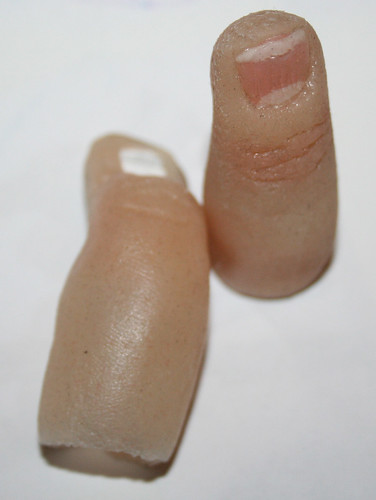
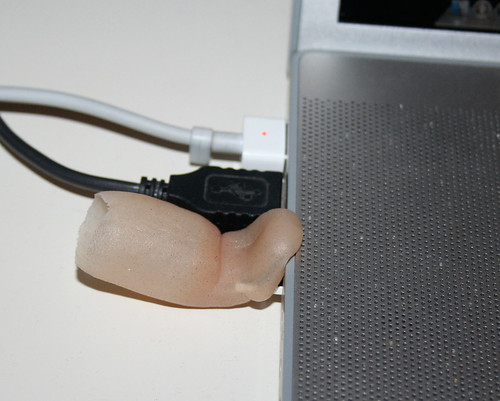
Finn Creates USB Finger Drive
Jerry Jalava, a computer programmer who lost his finger in an accident, created a prosthetic finger that contains a USB drive:


UPDATE: Microsoft's SenseCam Aids Memory Recall
From the
"SenseCam is a wearable digital camera that is designed to take photographs passively, without user intervention, while it is being worn. Unlike a regular digital camera or a cameraphone, SenseCam does not have a viewfinder or a display that can be used to frame photos. Instead, it is fitted with a wide-angle (fish-eye) lens that maximizes its field-of-view. This ensures that nearly everything in the wearer’s view is captured by the camera, which is important because a regular wearable camera would likely produce many uninteresting images."
New study proves that Microsoft's sensory innovation aids memory recall
Technology Review Article
Images from Microsoft Research:
SenseCam Videos
Research and Publications


Sunday, March 8, 2009
"Everyware" Health Care: A Personal Focus

For the next few weeks, I'll be focusing some on my experiences with technology and health care.
This time, my posts will be on a more personal level. As I write this post, I am sitting in the family waiting area of the cardiac ICU at the Cleveland Clinic. My dad's surgery was Tuesday, and it is now Sunday, so I have had plenty of time on my hands to observe how technology is used to deliver his care, monitor his progress, and support his recovery.
Since I view things from a broader human-computer interaction perspective, I've decided to share some of my thoughts the"Hospital UX" picture, putting myself in the shoes of patients, family members, and medical professionals.

This is the new lounge where families wait while their loved ones undergo cardiac surgery. The old family waiting area at the Cleveland Clinic had a cozy, home-like feel, with comfortable chairs and cheery art. The new waiting area has a very sterile, minimalist feel. The chairs are NOT comfortable, especially if you are middle-age or older and have the usual aches and pains!
Corridor to Nowhere?

Some of the corridors at the hospital have a surreal, institutional feel.
Hospital Corridor Eye Candy

You are.... where?!

It is still quite difficult to figure out where you are and how to get to where you are going.
Microsoft Health Common User Interface: Patient Journey Demonstrator
via Martin Grason: Adventures of a 'Devigner'
Future Hospitals form Designit 12/30/08
"How can hospitals offer a better service – for patients and visitors? And improve working conditions for staff? Designit has been asked to find the answer by applying explorative, user-driven innovation at the heart of public sector delivery: Odense University Hospital, Denmark's largest hospital."
"The project, which starts in January, aims to deliver groundbreaking service innovation that could serve as a blueprint for future public healthcare improvements – in Denmark and abroad."
Obama's Plan to Digitize Medical Records Draws Criticism from Doctors
Dan Nosowitz, Gizmodo, 3/7/09
Computer Will See You Now
Anne Armstrong-Coben, New York Times, 3/5/09
"Now that I’ve been using a computer to keep patient records — a practice that I once looked forward to — my participation with patients too often consists of keeping them away from the keyboard while I’m working, for fear they’ll push a button that implodes all that I have just documented...Room is provided for text, but in the computer’s font, important points often get lost. I have half-joked with residents that they could type “child has no head” in the middle of a computer record — and it might be missed....The personal relationships we build in primary care must remain a priority, because they are integral to improved health outcomes. Let us not forget this as we put keyboards and screens within the intimate walls of our medical homes.."
Note: Anne Armstrong-Corben is a clinical professor of pediatrics at Columbia.
Obama's Big Idea: Digital health records
David Goldman, CNN Money 1/12/09
Friday, March 6, 2009
More cool stuff from the Web of Things blog...
I just had to share a little more info from Web of Things blog! Enjoy.
Discussing the Web of Things Lift '09
Internet of Things: Roadmap for the Future
Video from the Internet of Things Workshop at Lift'09
LIFT09 - Internet of Things Workshop - webofthings.com from vlad trifa on Vimeo.
Sample of Interesting Links from Web of Things:
Designing with RFIDNatural Interaction: The Real World, Naturally Interactive
Adam Greenfield's Speedbird
Yanko Design: Form Beyond Function
sixthsense: a wearable gestural interface (MIT Fluid Interface Group)
Palantiri Systems: Next Generation Device Connectivity - Collaborative Devices
Manifesto of Open Disruption and Participation (Eric Paulos, 2/20/09)
blip: Berkeley IP Implementation: IPv6 for TinyOS
Tom Igoe: notes on physical interaction, sustainability, networks, simians, cats, and more
also try: Tom Igo.net
For animal lovers: Sniftag
"The SNIF Tag gives you, a dog owner, peace of mind and a unique insight into your pet's activity around the clock. By monitoring your dog's actions at home, in the park, and when you're apart, the SNIF Tag lets you track behavioral patterns, determine fitness levels, and better understand the life of your dog."
The Web of Things, Wireless Sensor Networks, Embedded Systems, and (Everyware) Health Care
What is the Web of Things?
I just came across the blog of the same name. The concept is similar to the "Internet of Things", but in my opinion, Vlad and Dominique, the guys behind the blog, have wrapped the concept into a more "user-friendly" package. They have found a way to articulate this concept far better than my feeble attempts, and for this, I am very thankful.
Web of Things: Architecting the Web of Things, for techies and thinkers!
Here is what I lifted from the "About" Section of this blog, plus a few other quotes:
"What is WebofThings.com?
It is a web page founded by Vlad Trifa and Dominique Guinard, two researchers/geeks working at ETH Zurich and SAP Research Zurich. It is more a scrap book that is here to dump our thoughts ideas on our research and work topic, which is the Web of Things. Unlike most Web 2.0 sites that are about advanced powerpoint engineering, we talk about real things that’s under the hood.
There are three main topics in here. First technologies, this section is only for geeks, simply put. It’s about coding, developing toys, plugging kettles on the web (and we actually did that!). The second part is about new ideas, new technologies that are in the lab. It’s about research papers, and software philosophy, and about researchers worldwide. The third part is about end-users and products. You, me, but especially my grand-ma. It’s about products that exist, or at least should exist (or should not!). It’s about marketing and new ideas out there.
Thanks, but it doesn’t help. What is the Web of Things then?
It is an alternative vision to what the Web of tomorrow will look like. It’s about taking the Web as we know it and extending it so that anyone can plug devices to it. It’s basically about giving eyes, ears, and all kinds of sensory appendixes located worldwide to it. It’s about seamlessly connecting the physical world with the virtual.
Why do you want to change the Internet? What’s wrong with it?
Not much really. It’s just a little boring. It only contains data published by other humans, but it’s not enough linked with our physical reality, not real time / real world enough for our taste!
Why should I read this blog?
Well depends how much you care about technology. It’s both for geeks/hackers who need a playground to develop and try ideas. But it’s also for the security expert who wants to take part to make the Web a safer place to hang out. It’s also for people who want to find new ideas.
Cool! SAP has a blog!
Actually, not really. All what we write here is only our own opinions and thoughts, and doesn’t reflect the views of any of our employers. "
"One things that I don’t understand, is that most people in our field do not really like our approach, or maybe they simply don’t get it. Indeed, we’re kind of stuck between several worlds: wireless sensor networks (WSN) people that find our approach too esoteric, and HCI people that find it not enough sexy. It is a bit annoying, as people don’t take us very seriously, especially not WSN researcher. I overheard comments like “What? You want to use the Web to connect devices? hahaha! I can’t stop laughing, haha it hurts me! Come on, be serious dude! Using the Web for that!! Man, you’re great, I gotta call my colleagues to tell them your idea, they’re gonna *love* it“. Jeez! -Vlad Trifa"
"Let’s do something concrete with WSN, that works, and that’s usable, and that people will really need."
Note: When you visit the Web of Things blog, make sure you visit their links!
Why do I think this is important?
First of all, I'm someone who would love to take a class about embedded systems and wireless sensor networks. I got a taste of some of this in a ubiquitous computing class I took a couple of years ago, and I'm still fascinated with these concepts. Imagine a web-browser that could support all sorts of data streaming in from all sorts of things and places, an intelligent web browser that could make perfect sense of he wealth of information that is potentially "out in the wild".
I think that the Web of Things is a concept that will have numerous applications in the very near future. The arena that is foremost in my mind is health care.
Why? I've spent hours hanging around hospitals and health care facilities since my father's health took a down-turn a couple of years ago. If you've been in my shoes, you know what I mean.
I'm writing this from the family waiting room of the cardiac ICU at the Cleveland Clinic, where I've spent the better part of the week with my father, who had surgery and a few complications. I've had plenty of time to spend listening and observing.
Earlier today, as I was visiting my father in the ICU, I had a chance to chat with a nurse who was an IT guy in his previous life. I rarely have a chance to engage in "geek speak" in my day job as a school psychologist, so I welcomed the chance to talk about the concept technology and health care.
I asked the guy if he'd heard of the "Internet of Things", and we discussed how a cross platform web browser, linked to all of the various devices and patient monitors in the ICU could potentially solve many of the problems faced by nurses and related health professionals in their day-to-day tasks. The nurse pointed out that wireless technologies would eliminate the need for a number of the wires connected to my dad's body. That was a good point!
We had a good discussion about how software needs to be user-focused and user-friendly. In health care, as in many domains, it is not. Usable, intuitive software, at least in the health care setting, would decrease medical errors, increase efficiency, save time, save lives, and in the mid-to-long run, save lots of money.
Somewhat Related
(Previous post)
Everyware Health Care: Microsoft Health's Common User Interface, website, usable health care applications, pervasive health games.....
Wireless Sensor Networks for In-Home Healthcare: Potential and Challenges (pdf)
ALARM-Net: Wireless Sensor Networks for Assisted Living and Residential Monitoring
(Crossbow Blog, 9/28/08)
"Wireless Nodes Dynamically Link to Build Intelligent Sensing Networks"
John Suh, RTC 6/2005
Wireless sensor and data transmission needs and technologies for patient monitoring in the operating room and intensive care unit Paksuniemi, M., Sorvaja, H,; Alasaarela, E.' Mylyla, R. Engineering in Medicine and Biology Society, 2005, IEEE-EMBS 2005
Healthcare Service with Ubiquitous Sensor Networks for the Disabled and Elderly People
Yung Bok Kim & Daeyoung Kim, Computers Helping People with Special Needs 7/2006
Conferences:
Malignant Spaghetti: A Symposium on Wireless Technologies in Hospital Health Care
(A must-read if this topic is of interest)
S-CUBE 2009
The first international conference on Sensor System and Software
"The widespread acceptance of these new services can be improved by the definition of frameworks and architectures that have the potential to radically simplify software development for wireless sensor network based applications. The aim of these new architectures is to support flexible, scalable programming of applications based on adaptive middleware. As a consequence, WSNs require novel programming paradigms and technologies. Moreover the design of new complex systems, characterized by the interaction of different and heterogeneous resources, will allow the development of innovative applications that meet high performance goals. Hence, WSNs require contributions from many fields such as embedded systems, distributed systems, data management, system security and applications. The conference places emphasis on layers well above the traditional MAC and routing, and transport layer protocols."
Friday, February 20, 2009
User Experience and IKEA

I wrote about IKEA's interactive website in a previous post, before the new IKEA store opened in my area, and since then, I counted the days until it opened.
The grand opening was this week, and I went shopping there last night with one of my daughters.
I ate the Swedish meatballs in the cafeteria. I wanted to buy things.
We decided that IKEA uses some sort of aroma-therapy/mind control through out the store.
This was my first visit to an IKEA, and it was awesome. They had flat-panel televisions all over the place. I was hoping that one of the displays would be connected to that cute IKEA website, KOM IN I GARDEROBEN. The English version: Come Into the Closet.
It would have been fun to control the dancers while sitting on a showroom sofa, using gestures.
From the IKEA Website:
"This is a campaign to promote IKEA's wardrobe solutions. IKEA wanted to show their huge range of styles and all the smart features on the inside....All the movements on the web site are controlled by sound and music.So change songs, upload your own music, play on your keyboard or sing into the microphone."
For more details:IKEA's Interactive Dancing and Musical Website
Enjoy the site!
Wednesday, February 18, 2009
The Smart Table is now available for purchase!
Here is the plug:
"The world's first multitouch, multiuser table for primary education - the SMART Table - is now available for purchase.Order the SMART Table"
"As a collaborative learning center, the SMART Table enables engaging and motivating small-group learning experiences. Up to eight students can use their fingers intuitively to sweep, slide and spin objects on the interactive screen. The SMART Table's ready-made activities help primary students gain and further their skills in areas like counting and reading."
"The SMART Table also makes an ideal complement to whole-class activities on the SMART Board™ interactive whiteboard. It helps reinforce concepts in a small-group setting and ensures students can participate in interactive and creative learning experiences".
(Cross-posted on the TechPsych and Interactive Multimedia Technology blogs.)
Sunday, February 15, 2009
New York City Visitor's Center: Interactive Tables and Displays by GestureTek
The New York Visitor's Center is sleek and high-tech. The technology is the handwork of GestureTek, a company that focuses on gesture-based interactive surfaces, signs, displays, devices, and games.
Pictures below are from Steringely.com
Picture below is from static.worldarchitecuturenews.com
If interactivity captures your fancy, you might be interested in attending the upcoming Interactive Displays Conference, sponsored by Intertech Pira. This conference will highlight an interesting mix of existing and emerging interactive display technologies and applications. The conference will be held at the Hilton in San Jose, California, from Tuesday, April 21st through Thursday, April 23rd.
The pre-conference seminar will feature Sakuya Morimoto, of CANESTA, who will present his company's innovative single-chip 3D image sensor technology that supports gesture interaction.
Keynote speakers will be Jeff Han, of Perceptive Pixel, and Steven Bathiche, of Microsoft US.
More information about this conference is posted on the Interactive Multimedia Technology blog.


Video Clips of Projects Inspired by Johnny Chung Lee and Wiimote IR Tracking
Johnny Chung Lee, known for his experiments with the Wiimote and IR tracking from his graduate student days in the Human-Computer Interaction department at Carnegie-Mellon University, has posted a variety of video clips from his followers who have worked on projects inspired by his interesting work.
Take a look at Johnny's Procrastineering blog to see the videos!
Johnny Chung Lee
Sunday, February 8, 2009
Internet of People, Things, Surfaces, and Interactions: Insights from UX 2008 & Adaptive Path
Adaptive Path is a company full of forward-looking, creative people who focus on user experience, interaction design, and information architecture. It sponsors UX Week each year, which provides participants with a refreshing update on current trends in the field. The following videos are a sample of what was presented at UX 2008. I plan on updating this post soon with a few brief notes and comments.
If you are interested in learning more about all things related to UX, take some time to go through Adaptive Path's reading list!
Don Norman
Don Norman | UX Week 2008 | Adaptive Path from Adaptive Path on Vimeo.
Dennis Wixon
Dennis Wixon | UX Week 2008 | Adaptive Path from Adaptive Path on Vimeo.
Dan Saffer
Dan Saffer | UX Week 2008 | Adaptive Path from Adaptive Path on Vimeo.
Dave Wolf
Dave Wolf | UX Week 2008 | AdaptEDive Path from Adaptive Path on Vimeo.
Dave discusses his company's philosophy of software design process: "Right Software, Right Device, on the Right Area on the Network, or Not on the Network at All". He highlights how this philosophy was incorporated into his company's contribution, "Ben", to the Microsoft Phizz Pop Design Challenge competition. The visualization about on-line news is interesting, incorporating the little video comments, which enriches the understanding of commentary.
Tuesday, January 27, 2009
Locative and Mobile Media & The Mobile City Blog
In February 2008, a conference was held at the Netherlands Architecture Institute: The Mobile City: A Conference on Locative Media, Urban Culture and Identity I'll be visiting the site again soon, partly because there are quite a few interesting links. I just visited Christian Nold's BioMapping.net site. Biomapping is a community mapping project in which people weare Galvanic Skin Response recording devices as they explore their environment to create communal emotion maps that include data as well as personal observations. The project has grown and now has several map projects with their own websites. Christian Nold's main website is also worth exploring.
"The Mobile City is an initiative that focuses on locative and mobile media, urban culture and identity. We aim to bring professionals from different disciplines (academics, urban professionals, media designers, artists, telecom operators, etc) together to address the question: what happens to urban culture when physical and digital spaces merge?"
I think it is important to take an interdisciplinary approach when we think of emerging technologies, especially those that play out in public spaces, especially if we are interested in promoting these technologies for the "greater good".
It is worth exploring the Mobile City Blog. You can link to videos from the keynote speakers, find information about related conferences, such as the Digital Cities 6 Workshop (June 24, Penn State University), and check out the blogroll, which I've included in this post for convenience.
I especially liked the thoughtful review by Michiel de Lange of a chapter of a new book edited by Rich Ling and Scott W. Campbell. "The Reconstruction of Space and Time: Mobile Communication Practices"

Backround
"The Mobile City is an initiative by Martijn de Waal and Michiel de Lange. The first Mobile City Conference was organized with the Netherlands Architecture Institute and the research groups New Media, Public Sphere and Urban Culture at the University of Groningen, and Playful Identities at the the Erasmus University Rotterdam & University of Utrecht. Tijmen Schep is an occasional contributor to The Mobile City Weblog."
Here is the awesome Mobile Cities blogroll:
‘Playful Identities’ - Michiel de Lange Adam Greenfield Air Roots
Andrea Gaggioli Anthony Townsend ArchiNed - de architectuur site van Nederland
Blog Like You Give A Damn Changeist cityofsound Digital Urban
Digitaler Urbanismus Doors of Perception weblog
Home - Berkman Center for Internet & Society IFTF’s Future Now Informationlab
Institute for the Future - Future Cities Institute of Network Cultures Jan Chipchase
LIFT Conference Blog Mark Shepard Martijn de Waal Mimi Ito -Weblog
MIT Convergence Culture Consortium: Weblog Mixed Realities MobHappy
Mobi Mundi Mobilities neo-nomad New Media & Society recent issues
New Mobilities: Ce-more about what’s happening in the mobile world
Nicis Institute - Nicis Kenniscentrum Grote Steden pasta and vinegar
Performative Environments Planetizen Purse Lip Square Jaw
Relevant History Rhizome Ronald.waag.org Ruimtelijk Planbureau
Situated Technologies Small Surfaces Smart Mobs
Smartspace - Smartspace Journal Space & Culture The End of Cyberspace
The Mobile City The Where Blog thinkwhere Timo Arnall
urbanscreens.org varnelis.net - network culture Villes 2.0
we make money not art weekly INCITE Where
Where 2.0 - O’Reilly Conferences zengestrom.com
Monday, January 19, 2009
Touch Screen Interaction in Public Spaces: Room for Improvement if "Every Surface is to be a Computer"!
With Win7's "multi-touch" capabilities, Bill Gate's statement that every surface will be a computer might come true, but from what I can see, we have a long way to go before we get it right!
One of the concerns I have about "touch" screen interaction in public spaces is that not much thought is given to the environmental factors surrounding the system. The system that is tested for the first time after installation might work just fine, but not when it is put to use under a variety of conditions or situations.
EXAMPLES (I've recycled a few of these from previous posts.)


Below is a shot of my husband, trying to see what is on the screen. This photo shows exactly what the screen looked like at the time:

The next picture tells it all. You can see that there is some sort of alphabet on the right side of the screen, but the reflection of my husband is easier to see. We couldn't figure this one out.

The following clip demonstrates how environmental concerns, such as wind and "sideways" rain, can make an interactive display at a shopping center difficult to use. During this clip, you can hear me muttering about the difficulties I had interacting with the information on the touch-screen display. It is possible that the system wasn't working well because of the exposure to the elements.
In my opinion, an interactive wayfinding application should run on a larger display and support two or more people, since many hospital visitors often run in pairs or small groups.


