Sunday, April 18, 2010
MIT's Personas application: Online visualization of querying and categorization system that searches and displays traces of YOU! (Metropath(ologies) Installation)
MIT's Personas application: Online visualization of querying and categorization system that searches the internet for digital traces of YOU!
"Personas shows you how the Internet sees you. It is a critique of data mining, revealing the computer's uncanny insights and inadvertent errors. It is meant for the viewer to reflect on our current and future world where digital histories are as important, if not more important, than oral histories, and computational methods of condensing our digital traces are largely opaque and socially ignorant" - Aaron Zonman (creator of Personas)
I know that I'm all over the place on the Internet. One of my assignments several years ago was to create and maintain a blog, and at that point, I no longer was anonymous. The damage was done. Below are three versions of my name as seen by the Personas application. If you happen to have lots of information on the web, the application limits the search in a random fashion. The first two screenshots were two entries of the same version of my name, but the results were a bit different.


Personas Home Page (From the home page, you can link to information about how the application works. It uses natural language processing and topic modeling to generate the visualization.)
Here is the Personas application in the form of an interactive exhibition, "Metropath(ologies)":
Personas was created by Aaron Zinman, with help from Alex Dragulescu, Yannick Assogba and Judith Donath.
http://creativecommons.org/licenses/by-nc-sa/3.0/us/


Sunday, August 16, 2009
My First 100% Synthy Photosynth!
This morning I uploaded 17 pictures taken from the balcony of a cruise ship one morning when we docked in Ireland. I was expecting emerald green, but this is what I woke up to on that gray, drab day.
If you can't see the images below, you will need to go to the Microsoft Photosynth website at http://photosynth.net to get the required tools.
The pictures are fairly high-res, which makes it better for viewers to explore.
If you go to the Photosynth website, view this Photosynth in the Direct3D viewer, in full-screen. It is easy to navigate with a touch screen- I used my HP TouchSmart PC and was impressed with the fluid interaction, considering that this is a web-based application.
Haven't yet heard about Photosynth? Here is a description from the Photosynth website:
"Photosynth creates an amazing new experience with nothing more than a bunch of photos. Creating a synth allows you to share the places and things you love using the cinematic quality of a movie, the control of a video game, and the mind-blowing detail of the real world."
Sunday, November 23, 2008
Palantir of Orthanic: Facebook Visualization by Jack Lindamood, Kevin Der, and Dan Weatherford
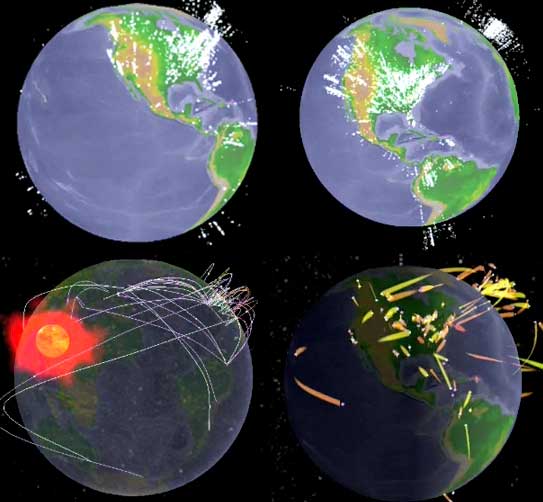
Via Chris Leoni's Information Technology blog
The Project Palantir visualizes geo-located actions that occur on Facebook, which is described in detail on the video.
"Facebook isn't just about actions, it is about interaction... each color represents a different type of interaction"
Thursday, March 27, 2008
OpenSpime, Sensors, Internet of Things, and Technology-Supported Human-World Interaction
Have you heard of the Internet of Things? Spime? OpenSpime? I've posted some information about these future-is-now concepts for those of you who are interested in keeping up with how technology is evolving "in the wild".
Royksopp's "Remind Me" video, is full of animated information visualizations that compliment the theme of this blog. The video also sets the stage for exploring the concepts behind the Internet of Things, Splimes, and OpenSpime.
According to the Internet of Things 2008 conference website, "The term "Internet of Things" has come to describe a number of technologies and research disciplines that enable the Internet to reach out into the real world of physical objects. Technologies like RFID, short-range wireless communications, real-time localization and sensor networks are now becoming increasingly common, bringing the Internet of Things into commercial use. They foreshadow an exciting future that closely interlinks the physical world and cyberspace - a development that is not only relevant to researchers, but to corporations and individuals alike."
According to futurist Bruce Sterling,"a Spime is an object that can be digitally tracked through space and time...Six emerging technologies converge to create new user experiences that connect networked data to physical things:
radio frequency identification (rfid)
global positioning systems
search engines
computer-aided design
digital fabrication
recyling"
The Spime Arrives is a good demonstration of the concept.
David Orban's OpenSpime Introduction: The World of OpenSpime: Infrastructure for an open Internet of Things, from ETech 2008
OpenSpime demonstration, using overlay on Google Maps:
Futurist Bruce Sterling, along with Scott Klinker, the 3-D Designer-in- Residence at Cranbrook Academy of Art, discuss the "big ideas" from the history of technology as they relate to the Internet of Things and Splimes this 49-minute video from Google Talks:
The Internet of Things: What is a Spime, and Why is it Useful?
"World-renowned Science Fiction writer and futurist Bruce Sterling will outline his ideas ... for SPIMES, a form of ubiquitous computing that gives smarts and 'searchability' to even the most mundane of physical products. Imagine losing your car keys and being able to search for them with Google Earth."
(inspiration for this post via Andrea Gaggioli's Positive Technology Journal: Mind, brain, and emerging technologies)
Interesting concepts.




