Sunday, February 5, 2012
LINK LIST!
Jason Silva's multimedia review of ABUNDANCE. Exponential Technological Progress. Less than two minutes.
Interactive Technology: Take a look at Corning's "Day Made of Glass 2: Unpacked" Video!
Razorfish Gesture and Touch Platform for the "Retail Experience"
Flight of the Fireflies, an Interactive Musical Poem/Game for the iPad, by Woolly Robot (video trailer)
Google in Education, Updated
iBooks Textbooks for iPads, iTunesU App- and links to info about 1:1 iPad initiatives in public schools
Quick Post: Link to a UX Gold Mine-Official Usability, User Experience, and User Interface Guidelines from Companies
GeekDad's Post: The Changing Nature of App Design for Kids
How to use game dynamics in the classroom, with good links, via Edudemic (Jeff Dunn)
Immersive Learning for Math using DimensionU Games- new "Play, Learn and Earn" with an allowance component.
Off-topic: "Communication technology for human-dog interaction" and "The secret life of my dog: design and evaluation of a paw tracker concept"....and my dog.
You Know You've Secretly Wanted to Learn to Code! (Info, links, video)
3D Plug-in for SMARTBoard Notebook (Video)
"Kinect-based Telepresence with Room Sized 3D Capture and Life Sized Display, Includes Behind-the-Scene "how-to" (UNC Chapel Hill)
Near-Field Communication in Education? Arts? Wayfinding?
iPads for every student in an elementary school in NC, Smartboards in the classrooms, and one awesome principal
Christian Bannister's Interactive Multi-touch and Gesture-based Bubcycle Project. Use your hands to shape sound, create, and manipulate music. Wow!!
UPDATE: EIST Call for Papers/Presentations
Kinect in Education! (kinectEDucation)
Now You See It: How the Brain Science of Attention Will Transform the Way We Live, Work and Learn, an awesome book from Cathy "HASTAC" Davidson
Near Field Communication (NFC) for Smartphones at the Museum of Londun, related video, and NFC links.
Quick Link: The Remote - Death by Voice Control?
46 Seconds of Steve Job's Wisdom-Vision
MozoCam Video Demos: Great for virtual field trips, awesome HD + fluid movement
FlatFrog Multi-touch Videos: Point Separation, Multi-input, Multi-user input
Starbucks Cup Magic: Augmented Reality App for iPhone and Android!
Revisiting Good Blogs: User Interface Engineering (Albrecht Schmidt, University of Stuttgart)
Revisiting Good Blogs: Eager Eyes (Robert Kosara, UNC-Charlotte)
TWINE video and the Supermechanical Blog: Moving Towards the Web of People and Things!
Revisiting Good Blogs: Nathan Yau's FlowingData


Thursday, July 30, 2009
David Orban's Internet of Things & Spime Design presentation at the Singularity University 2009
Below is David Orban's presentation about the Internet of Things and Spime Design at the 2009 Singularity University at the NASA Ames center.
More about the Singularity University will be included in my next post.
Wednesday, July 22, 2009
The IBM Web or Internet of Things: "A Smarter Planet"
I've noticed that IBM is permeating the masses with the "A Smarter Planet" campaign, and is also very busy building the Internet of Things. If you are like me and DVR your televisionnprogramming, you might have missed the following commercials featuring hardworking, smart IBMers:
Smart Cities
Smarter Info Management
Smarter Energy Grid
Smarter Math
IBM YouTube Advertising Channel
Here are a couple of good articles to read about this topic:
"Imagine a world with millions, perhaps trillions, of sensors that use IBM technology - because that's what Big Blue is imagining." IBM and The Internet of Things
7/22/09 Richard MacManus, Read-Write Web
The Internet of Things. Or Web 3.0
7/22/09 Adam Christensen, A Smarter Planet Blog
Monday, May 4, 2009
Pachube and the Internet of Things: Design, Ubicomp, RFID, and Usman Haque
I have a growing interest in the emerging "web of things", and figuring out how computers and gadgets can inter-operate more smoothly. This summer, I'm planning on playing with my RFID toys and learning more about wireless sensor networks. I can't wait until waiting for my MIR:ROR and Nabaztag arrive. I'm also looking forward to exploring the Pachube concept.
So what is Pachube?
Pachube: "A web service that enables people to tag and share real time sensor data from objects, devices and spaces around the world, facilitating interaction between remote environments, both physical and virtual."
You can sign up for Pachube on the web, and learn more about it by exploring the following links:
Pachube, Patching the Planet: Interview with Usman Haque
Ways to User Pachube
Pachube Website
Pachube Tutorials
Extended Environments Markup Language
EEML library for Processing
Pachube iGoogle Gadget: Create a monitoring dashboard
Usman Haque is an architect and director of Haque Design + Research.
"The domain of architecture has been transformed by developments in interaction research, wearable computing, mobile connectivity, people-centered design, contextual awareness, RFID systems and ubiquitous computing. These technologies alter our understanding of space and change the way we relate to each other. We no longer think of architecture as static and immutable; instead we see it as dynamic, responsive and conversant. Our projects explore some of this territory."
(cross-posted on the Interactive Multimedia Technology blog)
Friday, April 3, 2009
The Internet of Things can be Cute: MIR:ROR by Violet:
The MIR:ROR application supports memory and interaction with your computers as well as your Web 2.0 applications via a RFID Stamp. You can even figure out the last time you fed your fish!
Here is some of the promotional information from the Violet website:
"Mir:ror makes your everyday objects interactive, intelligent, communicant. Stick RFID Ztamps on them and show them to the Mir:ror: your keys will send e-mail to tell someone you’ve got home, your pills know when you’ve swallowed them, your toys play videos… Thousands of uses you can easily program through a Website."


"Nano:ztags are lovable micro-rabbits with a RFID Ztamp in their tummy. Program them to play any content or application you choose each time you show them to a Nabaztag:tag or Mir:ror."
(Also posted on the Interactive Multimedia Technology Blog)
Monday, March 30, 2009
RFID, Mobile Devices, and Museum Interaction
The above video demonstrates how RFID technology from Anerian can enhance the user's experience in museum settings. The prototype allows people to drive down micromedia-audio, video, or text to mobile devices to gain more information. The system also provides real-time analytics about the way visitors interact in museums.
Sunday, March 22, 2009
The Lucid Project: Internet of Things, Mobility, and Context Aware Services
The following picture, from Open Gardens, shows how our mobile devices can be used to interact with the "Internet of Things", also known as the "Web of Things":
The Open Gardens blog is authored by Ajit Jaokar.
The slides below are from one of Jaokar's presentations about the impact of open source technologies and mobile communication:
Related to this topic is the concept of mobile social software, also known as MoSoSo. For more information read this paper about Mobile Social Software, a thesis written by Clint Heyer.
Friday, March 6, 2009
More cool stuff from the Web of Things blog...
I just had to share a little more info from Web of Things blog! Enjoy.
Discussing the Web of Things Lift '09
Internet of Things: Roadmap for the Future
Video from the Internet of Things Workshop at Lift'09
LIFT09 - Internet of Things Workshop - webofthings.com from vlad trifa on Vimeo.
Sample of Interesting Links from Web of Things:
Designing with RFIDNatural Interaction: The Real World, Naturally Interactive
Adam Greenfield's Speedbird
Yanko Design: Form Beyond Function
sixthsense: a wearable gestural interface (MIT Fluid Interface Group)
Palantiri Systems: Next Generation Device Connectivity - Collaborative Devices
Manifesto of Open Disruption and Participation (Eric Paulos, 2/20/09)
blip: Berkeley IP Implementation: IPv6 for TinyOS
Tom Igoe: notes on physical interaction, sustainability, networks, simians, cats, and more
also try: Tom Igo.net
For animal lovers: Sniftag
"The SNIF Tag gives you, a dog owner, peace of mind and a unique insight into your pet's activity around the clock. By monitoring your dog's actions at home, in the park, and when you're apart, the SNIF Tag lets you track behavioral patterns, determine fitness levels, and better understand the life of your dog."
The Web of Things, Wireless Sensor Networks, Embedded Systems, and (Everyware) Health Care
What is the Web of Things?
I just came across the blog of the same name. The concept is similar to the "Internet of Things", but in my opinion, Vlad and Dominique, the guys behind the blog, have wrapped the concept into a more "user-friendly" package. They have found a way to articulate this concept far better than my feeble attempts, and for this, I am very thankful.
Web of Things: Architecting the Web of Things, for techies and thinkers!
Here is what I lifted from the "About" Section of this blog, plus a few other quotes:
"What is WebofThings.com?
It is a web page founded by Vlad Trifa and Dominique Guinard, two researchers/geeks working at ETH Zurich and SAP Research Zurich. It is more a scrap book that is here to dump our thoughts ideas on our research and work topic, which is the Web of Things. Unlike most Web 2.0 sites that are about advanced powerpoint engineering, we talk about real things that’s under the hood.
There are three main topics in here. First technologies, this section is only for geeks, simply put. It’s about coding, developing toys, plugging kettles on the web (and we actually did that!). The second part is about new ideas, new technologies that are in the lab. It’s about research papers, and software philosophy, and about researchers worldwide. The third part is about end-users and products. You, me, but especially my grand-ma. It’s about products that exist, or at least should exist (or should not!). It’s about marketing and new ideas out there.
Thanks, but it doesn’t help. What is the Web of Things then?
It is an alternative vision to what the Web of tomorrow will look like. It’s about taking the Web as we know it and extending it so that anyone can plug devices to it. It’s basically about giving eyes, ears, and all kinds of sensory appendixes located worldwide to it. It’s about seamlessly connecting the physical world with the virtual.
Why do you want to change the Internet? What’s wrong with it?
Not much really. It’s just a little boring. It only contains data published by other humans, but it’s not enough linked with our physical reality, not real time / real world enough for our taste!
Why should I read this blog?
Well depends how much you care about technology. It’s both for geeks/hackers who need a playground to develop and try ideas. But it’s also for the security expert who wants to take part to make the Web a safer place to hang out. It’s also for people who want to find new ideas.
Cool! SAP has a blog!
Actually, not really. All what we write here is only our own opinions and thoughts, and doesn’t reflect the views of any of our employers. "
"One things that I don’t understand, is that most people in our field do not really like our approach, or maybe they simply don’t get it. Indeed, we’re kind of stuck between several worlds: wireless sensor networks (WSN) people that find our approach too esoteric, and HCI people that find it not enough sexy. It is a bit annoying, as people don’t take us very seriously, especially not WSN researcher. I overheard comments like “What? You want to use the Web to connect devices? hahaha! I can’t stop laughing, haha it hurts me! Come on, be serious dude! Using the Web for that!! Man, you’re great, I gotta call my colleagues to tell them your idea, they’re gonna *love* it“. Jeez! -Vlad Trifa"
"Let’s do something concrete with WSN, that works, and that’s usable, and that people will really need."
Note: When you visit the Web of Things blog, make sure you visit their links!
Why do I think this is important?
First of all, I'm someone who would love to take a class about embedded systems and wireless sensor networks. I got a taste of some of this in a ubiquitous computing class I took a couple of years ago, and I'm still fascinated with these concepts. Imagine a web-browser that could support all sorts of data streaming in from all sorts of things and places, an intelligent web browser that could make perfect sense of he wealth of information that is potentially "out in the wild".
I think that the Web of Things is a concept that will have numerous applications in the very near future. The arena that is foremost in my mind is health care.
Why? I've spent hours hanging around hospitals and health care facilities since my father's health took a down-turn a couple of years ago. If you've been in my shoes, you know what I mean.
I'm writing this from the family waiting room of the cardiac ICU at the Cleveland Clinic, where I've spent the better part of the week with my father, who had surgery and a few complications. I've had plenty of time to spend listening and observing.
Earlier today, as I was visiting my father in the ICU, I had a chance to chat with a nurse who was an IT guy in his previous life. I rarely have a chance to engage in "geek speak" in my day job as a school psychologist, so I welcomed the chance to talk about the concept technology and health care.
I asked the guy if he'd heard of the "Internet of Things", and we discussed how a cross platform web browser, linked to all of the various devices and patient monitors in the ICU could potentially solve many of the problems faced by nurses and related health professionals in their day-to-day tasks. The nurse pointed out that wireless technologies would eliminate the need for a number of the wires connected to my dad's body. That was a good point!
We had a good discussion about how software needs to be user-focused and user-friendly. In health care, as in many domains, it is not. Usable, intuitive software, at least in the health care setting, would decrease medical errors, increase efficiency, save time, save lives, and in the mid-to-long run, save lots of money.
Somewhat Related
(Previous post)
Everyware Health Care: Microsoft Health's Common User Interface, website, usable health care applications, pervasive health games.....
Wireless Sensor Networks for In-Home Healthcare: Potential and Challenges (pdf)
ALARM-Net: Wireless Sensor Networks for Assisted Living and Residential Monitoring
(Crossbow Blog, 9/28/08)
"Wireless Nodes Dynamically Link to Build Intelligent Sensing Networks"
John Suh, RTC 6/2005
Wireless sensor and data transmission needs and technologies for patient monitoring in the operating room and intensive care unit Paksuniemi, M., Sorvaja, H,; Alasaarela, E.' Mylyla, R. Engineering in Medicine and Biology Society, 2005, IEEE-EMBS 2005
Healthcare Service with Ubiquitous Sensor Networks for the Disabled and Elderly People
Yung Bok Kim & Daeyoung Kim, Computers Helping People with Special Needs 7/2006
Conferences:
Malignant Spaghetti: A Symposium on Wireless Technologies in Hospital Health Care
(A must-read if this topic is of interest)
S-CUBE 2009
The first international conference on Sensor System and Software
"The widespread acceptance of these new services can be improved by the definition of frameworks and architectures that have the potential to radically simplify software development for wireless sensor network based applications. The aim of these new architectures is to support flexible, scalable programming of applications based on adaptive middleware. As a consequence, WSNs require novel programming paradigms and technologies. Moreover the design of new complex systems, characterized by the interaction of different and heterogeneous resources, will allow the development of innovative applications that meet high performance goals. Hence, WSNs require contributions from many fields such as embedded systems, distributed systems, data management, system security and applications. The conference places emphasis on layers well above the traditional MAC and routing, and transport layer protocols."
Sunday, January 4, 2009
Screens of All Sizes: Nielson Wire Report: Television, Internet and Mobile Usage in the US (3rd Quarter 2008)
Those of you who regularly follow this blog know that I'm obsessed with off-the desktop technology, including screens of all sizes, used in various situations and settings. On this blog, as well as the Interactive Multimedia Technology blog, I've noted how various disciplines and industries have been converging over time, often right in front of my eyes as I travel, shop, attend events, or hang out at home and elsewhere, by myself, with family, or with friends & colleagues.
Via Nielsen wire and The Web Outside blog:
Graphic from The Nielsen Company
(I will take this graphic down if requested.)
Although I've documented trends related to screen-based technologies at personal level, I haven't come across much hard data to support my hunches and observations. For this reason, I was happy to come across the report, Television, Internet, and Mobile Usage in the U.S., published the Nielsen Company. Here are some facts from the report, confirming what I've known in my bones for a while:
Summarized from page 4 of the report:
- Television remains the dominant screen for watching video, and time spent watching television has increased over the past year.
- People who watch recorded television, known in the industry as "timeshifted TV" also watch video online, but on average, but half as much.
- Men are likely to watch video on their mobile phones, and women are more likely to watch video on the Internet.
- During the third quarter of 2008, there was much online video content related to sports, politics, and finance, and online video use grew over the quarter.
Of course, television producers have made efforts to engage audiences across screens. For example, American Idol fans can vote with their cell phones, and people can visit sites related to their favorite television programs via their mobile devices (i.e. iPhones) when they are out and about. Web addresses are often flashed across the television screen, and CNN encourages viewers to share their video clips of news as it happens via "iReport".
The impulse to "cross-screen"** has carried over to movie theaters. On a recent visit to the theater, I noticed a sign forbidding texting during the show. Too many people were texting during the movies, I guess. Or maybe they were on-line, looking at movie trailers?
Television, Internet, and Mobile Usage in the US: A2/M2 Three Screen Report 3rd Quarter 2008 (pdf)
RELATED
A good resource for information about the Internet is the Pew Internet & American Life Project website. Here are a few good articles and reports, along with a few quotes from the sources:
Seeding the Cloud: What Mobile Access Means for Usage Pattens and Online Content (pdf)(John B. Horrigan)
"Our recent research shows that 62% of American adults have either accessed the internet wirelessly or used non-voice data applications, such as texting, emailing, taking a picture, or recording video, with a handheld. On the average day, 42% of those with cell phones or other wireless-enabled handhelds use the devices for at least one non-voice data application."
Mobile Access to Data and Information (pdf) (John B. Horrigan)
Networked Families (pdf) (Tracy L.M. Kennedy, Aaron Smith, Amy Tracy Wells, Barry Wellman)
"The internet enables shared "Hey, Look at this!" experiences."
"25% of online adults say that the internet has decreased the amount of time they spend watching television."
Adults and Video Games (pdf)
(Amanda Lenhart, Sydney Jones, Alexandra Rankin Macgill)
"More than half - 53% - of all American adults play video games of some kind, whether on a computer, on a gaming console, on a cell phone or other handheld device, on a portable gaming device, or online."
Demographics of Internet Users
Daily Internet Activities
Total Internet Activities
People are accessing the Internet more and more when not at home or at work, usually with their own device, and not a public screen or web-based interface.
This is changing, I think. Bill Gates says that every surface will be a computer, and we all know that computers = Internet. We are living in the dawning of the age of the Internet of Things, or should we say, the Internet of Screens?
Somewhat Related
Example of "cross-screen" interaction:
Fast-food operator serves up digital signage (via Self Service & Kiosk Association)
Monday, December 1, 2008
Usability & User Experience, A work in Progress: "Ubicomp is like a 5-year-old wishing for a pink pony"; "Ubiquitous Computing and UX Design"
I came across a post from the Near Future Laboratory's blog:
Ubicomp is like a 5-year-old wishing for a pink pony -Julian Bleeker
"Complete Ubicomp fail. I mean..they can't even get this most simple of scenarios straightened out and they want to put my refrigerator and toaster oven on the network?"
The author of the post was a guest at an upscale hotel room that featured sensors that turned on the lights. Unfortunately, the lights turned on at random times, resulting in a sleepless night, and a grumpy, resentful blogger. A great example for the Usability Hall of Shame.
Via Thomas Purves: "Apparently no one really wants to reboot their socks."
To learn more about about UX and ubiquitous computing, see Mike Kuniavsky's post, "Ubicomp UX Design at Dansk-IT" and the link to his keynote presentation, "Ubiquitous Computing User Experience Design".
Sunday, November 2, 2008
The Internet of Things: More from CNN -Internetting every thing, everywhere, all the time; Sensor networks for the elderly
The Internet of Things has gone mainstream.
Yesterday I posted about David Orban's recent presentation at SHiFT 08: Sensor Networks and Data for the Open Internet of Things, and embeded the video clip, "Why We Need to Listen to our Things". I planned on revisiting this topic in a couple of weeks, but this morning, I came across two related articles that I wanted to share right away.
The first article, Internetting everything, everywhere, all the time, by Cherise Fong, for CNN, discusses the basics, and includes links to additional information about concepts, such as RFID, or Radio Frequency Identity technology, NFC (Near Field Communication), Spime, Nabaztag, Oyster, Octopus, Suica, Mirror, Tikitag, Violet, Mir:ror, ztamps - with links for the tech-curious.
What interested me the most was EEML, or Extended Environments Markup Language, which is "a protocol for sharing sensor data between remote responsive environments, both physical and virtual. It can be used to facilitate direct connections between any two environments; it can also be used to facilitate many-to-many connections as implemented by the web service Pachube, which enables people to tag and share real time sensor data from objects, devices and spaces around the world....Possible end-users range from construction managers, large-building occupants and architects, to electronics manufacturers and interactive artists and designers."
I came across the second related article in this morning's Sunday paper. The Charlotte Observer printed an article by Bob Moos, of the Dallas Observer, about the use of emerging technologies to help the elderly stay in their homes:
Robots, sensors to help elderly stay at home: Devices will detect when residents have sleepless nights or forget to take their medication

Photo via the Charlotte Observer, by Michael Mulvey - MCT Photo
Note: The system is running on Debian
The National Science Foundation and other sources have worked to fund the Heracleia Human-Centered Computing Laboratory at the University of Texas at Arlington. One of the focus of current research is to develop "smart" homes that are embedded with networks of sensors and webcams to support the independence of elderly people, without seeming like the system is an invasion of privacy. This technology, as well as related technologies, will be demonstrated at the Silvers Summit on Saturday, January 10, 2009 at the International Consumer Electronics Show (CES).
Related:
SmartSilvers Alliance
More about David Orban and OpenSpime:
If you are interested in emerging technologies and pervasive computing, you'll find Orban's blog facinating. It is published in English, Italian, and Hungarian. He's involved in several Web 2.0 communities, including Second Life. He is also a member of OpenSpime, where you can read his post that covers the topics in his SHiFT '08 presentation.
Listening to our objects (10/27/08)
Excerpt from post:
"The granularity, frequency, and intensity of the chatter that the spimes in the network perform will be vital, and it will be a fundamental task to be able and reliably translate from their plane of communication to the one of aggregated, second-order knowledge, where we can understand it, where we can derive useful, valuable information which we can act upon!"
OpenSpime:
"OpenSpime is a project of WideTag, Inc., a technology infrastructure company incorporated in California, USA, providing hardware and software solutions for an Open Internet of Things."
"The OpenSpime technology enables individuals, corporations, and governments to better understand the environment surrounding them. A new generation of GPS-enabled sensor networks, based on the open source OpenSpime communication protocol will collect the necessary data, and using scalable server technology, aggreate, manage, and visualize the data collected."

Snail Mail: RFID-enabled real snail, carrying e-mail.
"Our snails are equipped with a miniaturised electronic circuit and antenna, enabling them to be assigned messages. Your message is collected from a despatch centre at one end of their enclosure. Once associated with the tiny electronic chip on the snail's shell your message will be carried around until the snail chances by the drop off point. Here more hardware collects your message and forwards it to its final destination."
Apple's Personal Area Network Systems and Devices patent via SlashGear
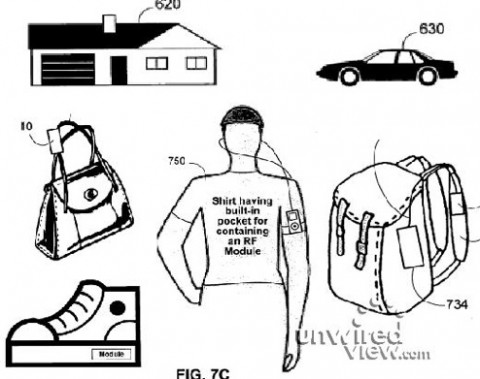
IPSO Alliance: Promoting the use of IP for Smart Objects: "Welcome to the launch of the Internet of Things"
"Today, with this association, we are creating the foundation which makes the Internet of Things a reality. We are bringing together companies across the globe with the objective of using IP to interconnect physical objects with the global Internet. Through our Technical Advisory Board we will document, demonstrate and teach how IP can be used in Smart Objects and provide IPSO members with updates on technology standards. This IP Smart Object technology will play an essential role in the challenge to master our energy distribution and consumption, automate our homes and work environments, modernize our cities and satisfy many other market requirements" -Geof Mulligan, Chairman; Patrick Wetterwald, President, JP Vasseur, TAB Chairman
IPSO Alliance FAQ's
RFID Weblog
Ann Galloway's Internet of Things Working Bibliography
Privacy and Security Issues, RFID, and the Internet of Things
As RFID tracking booms, privacy issues loom (Chris Taylor, CNN, 5/11/07)
Saturday, November 1, 2008
SHiFT 08: Sensor Networks and Data for the Open Internet of Things
I first learned about the "Internet of Things" nearly two years ago when I was taking a Ubicomp class. Since that time, things have sped quickly along in the research arena, but I don't think most folks are aware of how this technological transformation will impact our daily lives.
The videoclip below is from David Orban's presentation at SHiFT 08, "Why We Need to Listen to our Things":
Orban discusses how we currently spend much of our time taking care of our mobile devices, but as the magnitude of devices increasing, it is difficult to manage things as we have in the past. There is just too much data...There is a need for obtaining information from sensor networks. "We must derive deep knowledge of the environment from these sensors." In the video clip, Orban goes on to discuss the various challenges in this field:
- Signal to Noise problem.
- Signal to Signal problem.
- Management of the sheer volume of data that is generated, or will be generated - how data is filtered and analysed.
- Dependability - managing spime systems and sensor networks of tens of billions of elements.
- Aggregation of data to derive second order knowledge.
- New phenomena will surprise us in the future, we will learn more about our environment, and listen to our planet more clearly.
October 2008
Related:
SHifT 08 was held in Lisbon, Portugal on October 15-17. The focus of this year's conference was Transient Technologies, "in the sense that technology is breaking up with it's digital boundaries and it's becoming a vital part of a lot of the things we do and interact with in our daily lives."
The themes of SHiFT 08 included user experience, mobile computing, sustainability, the social web, web design, open technologies, digital media, artificial intelligence, spimes, and knowledge & innovation.
Saturday, August 30, 2008
Link to "Internet of Surfaces" Photo Examples
Here is a link to a wide assortment of photos that provide examples of what an "Internet of Surfaces" might look like:
INTERNET OF SURFACES: Photo Examples of Screens of All Sizes
Some of the photos are from my team projects. Other photos are from the Microsoft Surface website, NUI-Group members, and odds and ends from other sources.
Saturday, August 9, 2008
Internet of Surfaces?
Internet of Surfaces? Microsoft's Pete Thompson discusses screens and surfaces of all sizes.
(Video clip via gottabemobile, plus a few of my comments related to surfaces and universal usability, on the Interactive Multimedia Technology blog.)
Friday, June 27, 2008
Off-the-desktop musings about future interactions: User experience, user-driven design, Universal Usability, Airports, and the "Internet of Things"
 My vision for technology supported human-world interaction is much different than what I see cropping up in public spaces, despite emerging technological concepts such as the Internet of Things and Locative Media
If you are familiar with my blogs, you know that I maintain an on-going quest for off-the-desktop examples for my "Usability Hall of Fame". While I'm out and about, I often meet with disappointment, especially when I come across large displays or interactive touch screens.
The video clip below, taken on June 26th at the Detroit Metro Airport, is an example of what I mean. I was excited to encounter a touch screen information kiosk. I was not impressed with the clunky look and feel of the application. It was more like a point and click web-page than an innovative interactive information portal.
If you look closely, you'll see that the weather posted on the screen did not accurately represent the near 90-degree heat that I encountered that day. The weather information must not have been updated!
This kiosk was located in a new terminal. Although there were many information displays dotted around, during the two hours that I was at the airport, I never once saw anyone use them.

It is sort of difficult to use a touch screen when there is a garbage can obstructing the interaction.

It is not possible to interact with an interactive touch screen that is not working.
I did see people take a look at the more traditional, non-interactive displays that were located in the center walkways:

Last week, when I went to find my baggage at the Detroit Metro Airport, I noticed three kiosks on my way to pick up my luggage. At the time, I didn't know where I needed to go to retrieve my bags, and I wasn't sure where I needed to go to take the shuttle to the rental car lot. I was a bit puzzled to find these kiosks in this spot, since they did not provide the kind of information that most people coming through this section of the airport would need.


The above information kiosks were situated in a row of three, one representing each of the counties that make up the Detroit metropolitan area. Since the kiosks were located at the foot of the escalators leading to the baggage claim section of the airport, people stopping to interact with the kiosks would most likely cause a minor traffic jam. Although the kiosks were in plain view, it was not difficult to see why they were not used, or even noticed.
- Most people who are on their way to the baggage claim area are focused on getting their luggage and heading out. They may not be in the mood to learn all that they can about the finer points of Macomb, Wayne, or Oakland counties from talking head infomercials.
- Although the kiosks provided a reasonable amount of screen "real estate", the design of the applications allowed for no innovative touch-screen interaction. The applications were displayed on touch-screen surfaces, with the upper section dedicated to video and the lower section activated for touch. This design provided only one type of touch interaction, a small area to touch in order to activate the video.
- The displays with information about baggage carousels were located in a spot out of view from this location.

Since I'm obsessed with displays, as soon as I found my bag, I walked up closer to see what was so important about this huge sign. Not until I got right up to the surface did I notice that it offered some interactivity:

If you happen to have your cell phone handy, you can get free sync ringtones from the display area while you wait for your bags, if you happened to notice this at first glance. Since I was carrying my purse and pulling a suitcase and smaller carry-on bag, I was in no position to fumble around for my phone to get a new ringtone. It wasn't a convenient location. Where could I set down my purse? What if I had kids in tow?
Obviously, the designers of this set-up thought that it would be a good idea to offer people the chance to download ringtones as they waited for their luggage. What did the designers forget? Perhaps they did not look at the bigger picture long enough to think through a workable, useful user experience.
It would make better sense to provide ringtones at a more convenient location in the airport, such as the waiting areas or around the food courts. A thoughtful re-design of this display would encourage this interaction in a way to let people know intuitively that a ringtone service was available.
After I left the baggage area, I headed to an information display that consisted of a small touch screen, an array of small lighted displays, and phones to find out how to get to the shuttle to the rental car lot. Again, I was not impressed. The applications were a bit more visually appealing than the displays in the terminal, but the touch screen interaction was clunky.


Related:
To get a better understanding of my message and the importance of looking at bigger picture issues such as user-experience, user driven design, and emerging off-the-desktop technologies, take some time to look over the work and writings of people like Julian Bleeker, Chris O'Shea, and others who are thinking along similar paths. Also check the resource links on the sidebar of this blog.
Below are a couple of interesting quotes from Julian Bleeker:
(Julian Bleeker is from the Near Future Laboratory, a design, development and research consultancy.)
"Forget about the Internet of Things as Web 2.0, refrigerators connected to grocery stores, and networked Barcaloungers. I want to know how to make the Internet of Things into a platform for World 2.0. How can the Internet of Things become a framework for creating more habitable worlds, rather than a technical framework for a television talking to an reading lamp? Now that we've shown that the Internet can become a place where social formations can accrete and where worldly change has at least a hint of possibility, what can we do to move that possibility out into the worlds in which we all have to live? " - Julian Bleeker, Ph.D: Why Things Matter: A Manifesto for Networked Objects: Cohabiting with Pigeons, Arphids and Aibos in the Internet of Things (pdf)
"At its core, locative media is about creating a kind of geospatial experience whose aesthetics can be said to rely on a range of characteristics ..from the quotidian to the weighty semantics of lived experience, all latent within the ground upon which we traverse". -Julian Bleeker; Jeff Knowlton Locative Media: A Brief Bibliography and Taxonomy of GPS-Enabled Locative Media Leonardo On-line Electronic Almanac
Coincidence?
Julian Bleeker spends time contemplating interactions while he's in airports: Time Spent, Well
Chris O'Shea's blog, Pixelsumo, "is a blog about play, exploring the boundaries of interaction design, videogames, toys, and playgrounds. Chris is a resident of somth;ng labs, a shared studio space full of creatives who incorporate technology into their work.
- SURFACES: Chris O'Shea's posts and links pertaining to interactive surfaces, displays, touch-screens, and multi-touch.
- PLAYGROUNDS: Posts and links about technology-supported playgrounds
Airport Technology for the Usability Hall of Fame!
Embedded Information: Airport
Thursday, March 27, 2008
OpenSpime, Sensors, Internet of Things, and Technology-Supported Human-World Interaction
Have you heard of the Internet of Things? Spime? OpenSpime? I've posted some information about these future-is-now concepts for those of you who are interested in keeping up with how technology is evolving "in the wild".
Royksopp's "Remind Me" video, is full of animated information visualizations that compliment the theme of this blog. The video also sets the stage for exploring the concepts behind the Internet of Things, Splimes, and OpenSpime.
According to the Internet of Things 2008 conference website, "The term "Internet of Things" has come to describe a number of technologies and research disciplines that enable the Internet to reach out into the real world of physical objects. Technologies like RFID, short-range wireless communications, real-time localization and sensor networks are now becoming increasingly common, bringing the Internet of Things into commercial use. They foreshadow an exciting future that closely interlinks the physical world and cyberspace - a development that is not only relevant to researchers, but to corporations and individuals alike."
According to futurist Bruce Sterling,"a Spime is an object that can be digitally tracked through space and time...Six emerging technologies converge to create new user experiences that connect networked data to physical things:
radio frequency identification (rfid)
global positioning systems
search engines
computer-aided design
digital fabrication
recyling"
The Spime Arrives is a good demonstration of the concept.
David Orban's OpenSpime Introduction: The World of OpenSpime: Infrastructure for an open Internet of Things, from ETech 2008
OpenSpime demonstration, using overlay on Google Maps:
Futurist Bruce Sterling, along with Scott Klinker, the 3-D Designer-in- Residence at Cranbrook Academy of Art, discuss the "big ideas" from the history of technology as they relate to the Internet of Things and Splimes this 49-minute video from Google Talks:
The Internet of Things: What is a Spime, and Why is it Useful?
"World-renowned Science Fiction writer and futurist Bruce Sterling will outline his ideas ... for SPIMES, a form of ubiquitous computing that gives smarts and 'searchability' to even the most mundane of physical products. Imagine losing your car keys and being able to search for them with Google Earth."
(inspiration for this post via Andrea Gaggioli's Positive Technology Journal: Mind, brain, and emerging technologies)
Interesting concepts.




