Friday, May 3, 2013
Linkfest (for your tech-reading pleasure)
Here's an update of links to posts from my Interactive Multimedia Technology blog. Similar content can be found on my Pinterest boards.

OpenPilot: A Next-Gen Open Source Autopilot Approach to Aerial Videography
XBox Kinect in the OR: Kinect supports gesture interaction with 3D imaging of the patient, while operating.
Telemedicine in Schools: Promoting Health (and Mental Health)
InteractiveTV Today (ITVT): Links to information and updates about CES 2013, via Tracy Swedlow.
Gesture Markup Language (GML) for Natural User Interaction and Interfaces
CCRMA Summer Workshops: Stanford's Center for Computer Research in Music and Acoustics
Disney Research: Touche, Touch and Gesture Sensing
AirHarp for Leap Motion, a Responsive Musical Natural User Interface
Tips for Apps and the Web: Designing for Teens, Part I
Part II: Websites and Apps for Teens and Education
Designing for Touch & Gesture: Tips for Apps and the Web (Updated)
Affinity+: Semi-Structured Brainstorming on Large Displays, from Pacific Northwest National Library
Call for Papers: Human-Computer Interaction and Learning Science
Update: What's New for Kinect? Fusion, real-time 3D digitizing, design considerations, and more.
Interactive MaKey MaKey: "An Invention Kit for Everyone" - Video Preview
Google Glass and Kids- BYOGG? Quick links to MIT Tech Review Post - and more
Leap Motion: My Dev Kit Arrived - Now What? Thoughts About "NUI" Child-Computer Tech Interaction
Google Earth and Leap Motion
Quick Post/Videos: Evolving Soft Robots (Cornell's Creative Machines Lab); Leap Motion + Google Earth Experiment (PO-MO)
Little Digits Counting and Early Math App, by Cowly Owl- Chris O'Shea
Interesting Videos I Almost Missed (Future/Emerging/Creative Tech)
The Uncanny Valley is Here! Activision's real-time character demo is chilling real.
What happens when a 2-year-old wakes up to the sound of the Google Map Lady? "I CAN'T turn left right now!"
Pixel Press: Draw, create, play and share games, without code, now on Kickstarter.


Sunday, April 10, 2011
Immersive Cocoon Interaction: "It's people who are now the interface"
I found the above quote from the Immersive Cocoon website and smiled.
When I first learned about the Immersive Cocoon in 2008, I thought it was just another technological fancy that probably would not come to market anytime soon. Although it still is in the concept stage, I think it has a chance of making it, given the rapid advances in interactive technology over the past few years.
It wouldn't surprise me to see i-Cocoons finding a place in libraries, educational settings, museums, and other public spaces within the next 5-8 years, given an economic turnaround.
What is the Immersive Cocoon?
"The Immersive Cocoon is a future concept study by Tino Schaedler with design collective NAU; an idea to push the envelope and provoke a new conception of interface technology...Directed and 3D CG by Oliver Zeller. More info, behind the scenes and full credits at i-cocoon.com." -adNAU"
What is inside the cocoon?

Photo: arch.nau.coop

Photo: arch.nau.coop
Teaser Video:
Immersive Cocoon Concept Website
Designers developing virtual-reality 'Cocoon'
Mark Tutton, 9/12/08, Telepresence Options /Human Productivity Lab
Immersive Cocoon-Facebook
"NAU is an international, multidisciplinary design firm, spanning the spectrum from architecture and interior design to exhibitions and interactive interfaces. As futurists creating both visual design and constructed projects, NAU melds the precision of experienced builders with the imagination and attention to detail required to create innovative exhibits, public events and architecture."
FYI:
Concerning interactive technology, things have changed a bit in my corner of the world - as I write this post, there is a Kinect beckoning me to dance in my bonus room. The Kinect was something that came to market much sooner than I expected. I'll have an iPad2 sometime in the near future- another example of how rapidly things are evolving. I skim the news by touch/swiping my now-outdated HTC Incredible. My 88-year-old aunt, has used Skype more than once to "chat" with her baby great-nephew across the miles.
I use a Wii at work at least once a week to support social interaction skills with some students who have moderate-to-severe autism. Every classroom in the main school I serve has a huge, immersive, interactive whiteboard that relies on touch and kinesthetic interaction-my colleagues can't imagine going back to teaching without them.
Cross-posted on the Interactive Multimedia Technology blog.
Sunday, April 3, 2011
INTERACTIVE TABLETOPS AND SURFACES 2011 CALL FOR PAPERS AND NOTES (6th Annual ACM ITS 2011 - Nov. 13-16)
| Best Paper: | Proxemic Interaction: Designing for a Proximity and Orientation-Aware Environment by Till Ballendat, Nicolai Marquardt, Saul Greenberg | |
| Best Note: | MudPad: Tactile Feedback and Haptic Texture Overlay for Touch Surfaces by Yvonne Jansen, Thorsten Karrer, Jan Borchers | |
| Best Poster: | A Multi-Touch Alignment Guide for Interactive Displays by Mathias Frisch, Ricardo Langner, Sebastian Kleinau, Raimund Dachselt | |
| Best Demo: | MudPad - A Tactile Memory Game by Yvonne Jansen, Thorsten Karrer, Jan Borchers |
| Best Paper: | Proxemic Interaction: Designing for a Proximity and Orientation-Aware Environment by Till Ballendat, Nicolai Marquardt, Saul Greenberg |
| Best Note: | MudPad: Tactile Feedback and Haptic Texture Overlay for Touch Surfaces by Yvonne Jansen, Thorsten Karrer, Jan Borchers |
| Best Poster: | A Multi-Touch Alignment Guide for Interactive Displays by Mathias Frisch, Ricardo Langner, Sebastian Kleinau, Raimund Dachselt |
| Best Demo: | MudPad - A Tactile Memory Game by Yvonne Jansen, Thorsten Karrer, Jan Borchers |
Daniel Wigdor, one of the ITS 2011Program Co-chairs, co-authored the following book with Dennis Wixon. The book has not yet been released.
Brave NUI World: Designing User Interfaces for Touch and Gesture

Note: This post includes links, please let me know of anything I should correct.
TOUCH THE WEB 2011: 2nd International Workshop on Web-Enabled Objects Call For Papers
Sunday, February 20, 2011
BLUR Conference: Human Computer Interaction is Changing the World (Omni Orlando Resort, Feb 22-23)

"It’s easy to forget that the computer mouse is over 45 years old."
"What’s not as easy to forget is that we’re now collectively getting used to interacting with computers via means and interfaces that have moved way beyond the keyboard and the mouse — the iPhone and Wii being the most prominent examples."
"The truth is that we stand on the verge of a major revolution in the models of Human Computer Interaction (HCI). A revolution that will fly right past academic and into a world of retail, medical, gaming, military, public event, sporting, personal and marketing applications."
"From multi-touch to motion capture to spatial operating environments, over the next 10 years, everything we know about HCI will change."
"Blur is the only conference that is exploring the line of interaction between computers and humans in a substantive, real-world and hands-on way."
"At Blur, vendors, strategists, buyers and visionaries assemble to not only discuss the larger issues of HCI, but also to lay their hands on the latest in HCI technology. Blur is the only forum for a focused, hands-on exploration of the varied technologies evolving in the HCI."
"Come play, investigate, learn and apply at Blur — where we’re changing how you interact with computers forever." -Blur
BLUR Conference Agenda
(Note: I added the links to conference participants and/or their organizations. Feel free to leave a comment if you know of any corrections or better links!)
Keynotes:
Location as a Primary Interface Input - Matt Galligan, SimpleGeo; Nick Brachet, Skyhook Wireless
Robotics, Gaming and The Future of Entertainment- Paul Berberian, Orbotix
Virtual Coaches in Healthcare: A Vision of the Future - Dan Siewiorek, Carnegie Mellon University
10 reasons to be happy about giving computers emotion sensing - Dr. Rosalind Picard, MIT
Commercializing HCI Technology - Dr. Paul Kedrosky, Ewing Marion Kauffman Foundation and Dr. Gerry Barnett
Breakout Sessions:
Human Instrumentation - James Park, FitBit; Ben Rubin, Zeo; Jason Jacobs, RunKeeper;
Steve Larsen, moderator
New Museum Experiences: Learning from Multitouch and Multiuser Installations - Jim Spadacinni, Ideum
Kinect Hacks - Jonathan C. Hall; Lonergan Harrington; Jim Spadacinni, Sean Kean, moderator
Interactive Ads and Consumer Experiences - Alessio Signorini, Immersive Labs; Jon Fox, Helios Interactive
Augmented Reality - Ready for Primetime? - Vikas Reddy, Occipital; Carlin Getliffe, Omniar; Edwin Rivera, Credelis; Dan Rua, moderator
Building an Interface for Endangered Language Learners - Finn Thye and Kelson Adams, Univ of Colorado - Boulder
Alternative Interface Inputs - Gary Clayton, Nuance; Nick Langdale-Smith, Seeing Machines; RJ Auburn, Voxeo; Steve Larsen, moderator
Ewing Marion Kauffman Foundation "Idea Hack" - Commercializing HCI Technology: A Discussion - led by Paul Kedrosky
Building Natural User Interfaces - Thomas Peterson, SoftKinetic; Ohad Shvueli, Prime Sense; David Minnen, Oblong
3D Interactive Design for the Human Body - Albert Hwang
Panel: Will the Kinect Change the HCI Industry Forever? A Group Discussion
HCI in the 21st Century: Technologies for Extending and Amplifying the Human Experience (pdf) - Dr. Charlie Hughes, UCF; Dr. David Pratt; Dr. Joseph LaViola; moderated by Steve Fiore, UCF
Some Videos of HCI/Tech featured at Blur 2011
360 Panorama occipitalhq
"Illuminous" Eric Gradman
"Standard Gravity" Eric Gradman, OpenKinect (libfreenect/python)
Organic Motion Markerless Motion Capture
Advisory:
Steve Fiore, University of Central Florida
Bob Allen, Disney R&D
Kay Stanney, Design Interactive
Capt. Dylan Schmorrow, USN
Cross-posted on the Interactive Multimedia Technology blog.
Sunday, November 28, 2010
Media Facades: "When Buildings Start to Twitter" video timeline, via Thomas Schielke, of arclighting, plus lots of related links!
This morning I received a message from Thomas Schielke, of arclighting about his recent work. Included in his message was a link to this awesome video, Media Facades: When Buildings Start To Twitter, which is a video timeline of this history of media facades.
Below is a description of the video, by Thomas Scheilke:
"The timeline depicts international media facades with their different artistic, social or brand messages up to interfaces like iPhone Apps or brain sensors for public participation. The movie is a shortened version of the lecture, The semiotics of media facades - When buildings start to twitter" that was presented at the Parsons The New School for Design in New York in 2010."
Luminous tweets and retweets
"During the day, façade structures with their windows and material combinations grant a specific building image to the public. However, after sunset electrical light is the medium for an architectural image. The light appearance sends an atmospheric signal to the citizens like hang on in front of an asleep structure, look at an inviting but static façade or enjoy a vivid architecture sharing short stories. In the last decade, media facades have become a widespread element for luminous tweets. They establish a network between the building owner and the citizens, sometimes driven by aesthetical debates, other times by commercial intentions to avoid traditional light advertisement."
"The pursuit of persuasion by way of big screens gives the impression that size receives a higher relevance than content, comparable with the large amount of trivial tweets in Twitter. Various media facades appear as monumental monologues repeating a fixed animation daily. A few facades use signals from the environment and transform them into a play of light and shadow. Others emerge as urban dialogues when buildings show combined moving pictures. Some even allow people to send messages to the building to receive luminous retweets. They turn the city into a community following the dialogue and with the respective Apps may possibly even gain a following community worldwide."
"The historical overview of international projects covers various lighting methods and techniques from lighting designers as ag4, Arup Lighting, blinkenlights, Fusion, LAb[au], Licht Kunst Licht, L´Observatoire International, Mader Stublic Wiermann, Okayasu Izumi, magic monkey, Matthew Tanteri, Onur Sonmez , Qosmo, realities:united, StandardVision, Urbanscreens, Uwe Belzner, Yann Kersalé and architecture like Asymptote Architecture, Frank Gehry, Jean Nouvel, O.M. Ungers, Peter Cook, Peter Marino, UN Studio, schneider + schuhmacher, Simone Giostra, WOHA architects1. Artists like Doug Aitken, Jaume Plensa, Kurt Hentschläger and Zhong Song are included in the timeline as well." -Thomas Schielke
http://www.arclighting.de
FYI: Thomas is one of the authors of the book "Light Perspectives: Between Culture and Technology". Lean back and relax to the music as you watch a related video by Schielke: Light Architecture: Luminous Walls
Related info from Schielke's YouTube site:
Luminous walls: From clerestory windows via modernist wallwashing to pixelated planes
"The movie is a shortened version of the lecture that was presented at the Cornell University in the Department of Design and Environmental Analysis in Ithaca/USA (Oct. 18th 2010) and at the Columbia University in the Graduate School of Architecture, Planning and Preservation in New York (Oct. 26th 2010)."
"Luminous walls belong to the essential repertoire of qualitative lighting design. With light, spaces can be defined and reinterpreted. Illuminated walls allow us to provide orientation and to perceive the form and dimension of space. Further, their glow and play of brilliants could bestow a space with an impressing scenography. The timeline reveals different lighting approaches: From backlit clerestory windows for spiritual enlightenment in the gothic period to modernist uniform wallwashing. Contemporary examples will open the view for pixelated colour changing planes based on LED technology. The movie with an overview of international projects covers lighting methods and techniques for luminous walls and their visual appearance. With a perception-orientated design perspective the designer could use vertical illuminance to create bright spaces and thereby also contribute to sustainable lighting solutions."
"The overview of international projects from architects like Antonio Gaudi, Mies van der Rohe, Frank Lloyd Wright, Louis Kahn, Jean Nouvel, Peter Zumthor, Raffael Moneo, Toyo Ito, Christoph Ingenhoven and Karim Rashid or light artists as Peter Kogler and Erwin Redl covers various lighting methods and techniques for luminous walls and their visual appearance. Note: The image for 1814 needs to be reassigned to Bergisel Panorama in Innsbruck/Austria painted in 1897."
RELATED
Previous posts:
Revisiting Urban Screens: 555 Kubik Facade Projection Video; Info about Media Facades
More Urban Screens and Outdoor 3D Media Facades
Urban Screens, Urban Scenes, Media Facades: Obscura Digital's Outdoor iGoogle Artist Themes Launch in NYCU
Other LinksBook: Media Facades: History, Technology, and Content (M. Hank Haeusler)30+ Dazzling and Interactive Media Facades
Media Facades Festival 2010
Media Architecture Institute
International Urban Screens Association
Urban Screens
"URBAN SCREENS a project by Urban Media Research Berlin, investigates how the currently commercial use of outdoor screens and related infrastructure for digital moving images in urban space can be broadened with cultural content. We address cultural fields as digital media culture, urbanism, architecture and art. We want to network and sensitise all engaged parties for the possibilities of using the digital infrastructure for contributing to a lively urban society, binding the screens more to the communal context of the space and therefore creating local identity and engagement. The integration of the current information technologies support the development of a new integrated digital layer of the city in a complex merge of material and immaterial space that redefine the function of this growing infrastructure of digital moving images."
Urban Screens Video Channel
3d Projections on Buildings: A distinctive Way of Communicating
Communicating Through Architecture: Media Facades and the Digital Infrastructure The Rathous (Contains an assortment of videos and pictures)
Art and Commerce Meet on Building's Interactive Media Facades Kelsey Keith, Fast Company, 10/2/2009
Cross-posted on the Interactive Multimedia Technology blog.
Sunday, October 24, 2010
Augmented Realty Eyeglasses: I AM geeky enough to make this fashion statement!
THE AR WALKER, from NTT DoCoMo
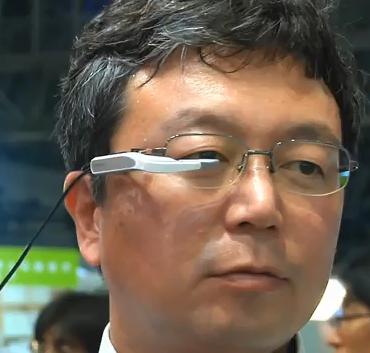
Of course, the fashionable get-up is in the prototype stage, so you won't be able be seen in public with the newest type of shades anytime soon. For more information, see the video below:
AR WALKER
RELATED
Cross-posted on the Interactive Multimedia Technology blog.
Saturday, September 18, 2010
Links to posts, videos, and pics related to interactivity and technology...
I've been busy lately, so here are some links to recent posts from my Interactive Multimedia Technology and TechPsych blogs that might be of interest:
Osmosis: Multi-touch systems for... everywhere!
Interactive 360-Degree Glass-less 3D Video Display with Gesture Sensor: Demo of Sony's RayModeler
Bill Buxton's Presentation Video: "A Little Tale about Touch" (Microsoft Worldwide Partner Conference, 2010)
Will the iPad rejuvenate journalism and sustain the growth of "slow media"? (Video via ZDNet)
Laying the Groundwork for Interactive Video Activities for Students with Special Needs: Community Road Trip
For Multi-Touch Techies and the Tech Curious: Touch and Retouch article, with code samples, by Charles Petzold
"The World Is Open: How Web Technology is Revolutionizing Education" - by Curtis J. Bonk
Almost missed this: "MSI Announces Availability of the World's First 3D Multi-touch All-in-one in America"
For the iPad: Reactable Multi-touch Mobile (also contains links to similar iPad applications)
Off Topic: Ad with 100 cute cats and kittens roaming free around IKEA (plus 2 video clips of cute kittens and 1 of "dancing" dogs)
For Techies and the Tech-Curious: A Few Links- IEEE Multimedia Innovations, Surface Computing, Usability, and Computer Education Research
A few interesting links- Innovative Interactivity on Google's "Life In A Day"; rb.trends "Mind Music"; Strombergs Blog "The Future of TV, Augmented and Social"
iPad Apps: Supporting Communication for Young People with Autism (& Links to Moms with Apps)
Planet in Action's 3D Sound in Google Earth: Part of the Interactive, Touchable 3D Picture (and thoughts about how this might play out on interactive whiteboards in education)
Video Experiments: Sea Life Medley-Extended Version with Music
Propellerheads' Gigantic Outdoor Drum Machine: Another "Playful Interface" and Media Facade - Using Phidgets!
Update & Links about the Interface Culture Exhibition at the 2010 Ars Electronica Festival, via Martin Kaltenbrunner
iRiS Interaction at the Playful Interface Cultures Exhibition & Ars Electronica Festival (video, short post, and links)
I wish I could go to the Playful Interface Exhibition at the Ars Electronica Festival!
Settlers of Catan Game by Vectorform Game Studio, on a Microsoft Surface
Interactive: Mirror Fun and Diamonds Alchemy Game, by Playbat
Saturday, September 5, 2009
The World is My Web Browser: Interactive Technology in Public Spaces
Off-the desktop Interactive technologies are spreading quickly, across many platforms. It seems that within the next 3-5 years we will be able to have instant access to a social and dynamic web, with information and entertainment at our fingertips, anywhere we go.
The "world-as-web-browser" concept is one I've touched upon in the past. I'd like to focus on this topic in future posts.
I came across some of the information in this post on the Future of Media Blog,maintained by the folks at the Interpublic Emerging Media Lab, based in California. This blog is a must-read!
The Saatchi & Saatchi ad agency in the UK created interactive games that provide people waiting in bus shelters the opportunity to pass the time by bashing digital falling eggs.
A more utilitarian approach to interactive touch screens is the EyeStop bus stop, a concept created by researchers MIT's SENSEable City Lab, along with the city of Florence and the city's transit service:

MIT

MIT researchers unveil the EyeStop: "Bus stop of the future" can sense its surroundings (pdf)

SOMEWHAT RELATED
IPG Future of Media Blog
(Cross-posted on the Interactive Multimedia Technology blog.)
Thursday, July 30, 2009
Singularity University? What about a Singularity Community College, with a mobile/distance learning option?
After I posted David Orban's presentation about the Internet of Things and Spime Design, which was part of the 2009 Singularity University, I took a deeper look at the Singularity University website. There are 3-day and 10-day programs geared for executives, and a 9-week Graduate Studies Program.
The Singularity University, held at the NASA Ames Research Center, "aims to assemble, educate and inspire a cadre of leaders who strive to understand and facilitate the development of exponentially advancing technologies and apply, focus and guide these tools to address humanity’s grand challenges."
The tuition for the 9-week program of study at the Singularity University is $25,000.00. It is not an inclusive environment, from what I can tell from the description of the ideal Singularity University student:
1. "We are looking for students who are creative, intelligent, and driven-for-excellence from around the world."
2. "Experts in one of the 10 track areas, and have a passion to learn about other tracks."
3. "They are proven leaders and entrepreneurs. We are looking for the next generation of CEPs, University Deans/Presidents and Government leaders."
4. "We are looking for internationalists: people who are bilingual or multilingual with a strong command of English (the language used to teach SU courses) and people who have traveled widely.
5. "They are interested in understanding and addressing the world's grand challenges."
The following tracks offered by the Singularity University include the following:
- Futures Studies & Forecasting
- Policy, Law & Ethics
- Finance & Entrepreneurship
- Networks & Computing Systems
- Biotechnology & Bioinformatics
- Nanotechnology
- Medicine, Neuroscience & Human Enhancement
- AI & Robotics
- Energy & Ecological Systems
- Space & Physical Sciences
What the world REALLY needs is a Singularity Community College, with the same faculty as the University version. The community college version would also provide a ubiquitous learning option for those of us too busy to attend courses in person.
Nine weeks, $250.00 a student. Transformation? Priceless.
For your convenience, below is some information about the movers and shakers affiliated with the Singularity University . The information is from the Singularity University website.
Faculty & Advisors
- Amara D. Angelica, Academic Model/Curriculum Lead, Singularity University
- Andrew Hessel, Open source biology, Founding Dir, Pink Army Cooperative
- Aubrey de Grey, Chair & Chief Science Officer of the Methuselah Foundation
- Ben Goertzel, Founder, Novamente LLC; Dir of Research, Singularity Inst
- Bob Metcalfe, General Partner, Polaris Venture Partners
- Bruce Damer, Founder CEO, DigitalSpace; Dir The Contact Consortium
- Burton Lee, Faculty, European Entrepreneurship & Innovation at Stanford
- Charles Du, Technology Catalyst, Singularity University
- Chris Boshuizen, Project/Events Planning Lead, Singularity University
- Chris DiBona, Open Source Program Manager, Google Inc.
- Christine Peterson, Vice President, Foresight Institute
- Christopher deCharms, Founder, Omneuron, Inc.
- Christopher Stott, Chairman and Chief Executive Officer of ManSat LLC
- Claire Tomkins, Project Manager: Gigaton Throwdown
- Dan Barry, President, Denbar Robotics, former NASA astronaut
- Dan Kammen, Co-director, Berkeley Institute of the Environment
- Dan Whaley, Founder and CEO, Climos
- Daniel Ford, Senior Mathematician, Google Inc.
- Daniel Kraft, Instructor, Cancer/Stem Cell Biology Institute, Stanford University
- Daniel Reda, Co-Founder, CureTogether
- Dave Blakely, Director of Technology Strategy, IDEO
- David Haussler, Professor, Biomolecular Engineering, UC Santa Cruz
- David Orban, Founder & Chief Evangelist at WideTag, Inc. (OpenSpime)
- David S. Rose, CEO Angelsoft, Managing Principal, Rose Tech Ventures
- David Tosh, Co-Founder of Elgg
- Dharmendra Modha, Manager, Cognitive Computing, IBM Almaden
- Donald James, Project Manager, International Space University
- Gary Martin, Director, New Ventures & Communications, NASA Ames
- George Smoot, University of California, Berkeley; 2006 Nobel Prize in Physics
- Henrik Bennetsen, Assoc Dir, Stanford Humanities Lab, Stanford University
- Howard Bloom, Author, The Lucifer Principle, and Global Brain
- J Storrs Hall, Pres, Foresight Inst; Author, Beyond AI & Nanofuture
- James Canton, CEO and Chairman of the Institute for Global Futures
- James Tracy, Educational Consultant, Singularity University
- Jason Lohn, Senior Research Scientist, Carnegie Mellon University
- Jeffrey Hoffman, MIT Professor of Aerospace Engineering, former NASA Astronaut
- Jerome C. Glenn, Director, The Millennium Project
- Jim Dator, Prof & Dir of the Hawaii Research Center for Futures Studies
- Jim Karkanias, Senior Director, Applied Research and Technology, Microsoft
- John Smart, Founder & President, Acceleration Studies Foundation
- Kathryn Myronuk, Library and Knowledge Resources, Singularity University
- Keith Kleiner, Associate Founder, Singularity University
- Kevin Epstein, Executive in Residence, Mohr Davidow Ventures
- Lanny Ebenstein, Professor, UC Santa Barbara
- Larry Smarr, Dir, CA Inst for Telecommunications & Information Tech
- Lauren Fletcher, Engineer, Astrobiology, NASA Ames Research Center
- Martin Greenberger, Professor, UCLA Anderson School of Management
- Mary Hodder, Founder of Dabble
- Matt Mullenweg, Founder, WordPress and Automattic
- Matt Rutherford, Media Producer, Singularity University
- Michel Gelobter, Founder, Cooler Inc; former Pres, Redefining Progress
- Michael Potter, Director, Paradigm Ventures
- Michael Simpson, President, International Space University
- Mike Linksvayer, Vice President of Creative Commons
- Natasha Vita-More, PhD cand, U of Plymouth; Vis Scholar, 21st Century Medicine
- Neil Jacobstein, CEO, Teknowledge; Media X Prog, Stanford Univ
- Patrick Lin, Director, The Nanoethics Group
- Paul Saffo, Visiting Scholar in the Stanford Media X research network
- Pete Worden, Director, NASA Ames Research Center
- Peter Diamandis, Founder, X PRIZE Foundation
- Peter Norvig, Director of Research, Google Inc.
- Raj Reddy, Prof of Computer Science & Robotics, Carnegie Mellon Univ
- Ralph Merkle, Senior Research Fellow, Institute for Molecular Manufacturing
- Ray Kurzweil, Founder, Kurzweil Technologies, Inc.
- Robert. A. Freitas, Jr, Sr Research Fellow, Inst for Molecular Manufacturing
- Robert Goldberg, Managing Director, Crossroads Ventures
- Robert Richards, Founder, Odyssey Moon Limited
- Robert Taylor, Mintz, Levin, Cohn, Ferris, Glovsky and Popeo, PC
- Rohit Khare, Former Director of CommerceNet Labs; Founder, Ångströ Inc.
- Salim Ismail, Executive Director, Singularity University
- Sarah Black, Kurzweil Liaison, Singularity University
- Sebastian Thrun, Prof of Computer Science and Dir, AI Laboratory at Stanford
- Sonia Arrison, Senior Fellow, Pacific Research Institute
- Stephanie Langhoff, Chief Scientist, NASA Ames Research Center
- Stuart Kim, Professor, Developmental Biology, Stanford University
- Sunil Paul, Founding Partner at Spring Ventures
- Susan Fonseca-Klein, VP of Operations, Singularity University
- Tara Lemmey is the CEO of LENS Ventures
- Terry Grossman, Founder and Medical Director of Grossman Wellness Center
- Timothy Ferriss, Author, The 4-Hour Workweek
- Tom Byers, Prof, Stanford Univ; Stanford Technology Ventures Program
- Troy Byrd, Education/Business Development, Singularity University
- Vint Cerf, Vice President and Chief Internet Evangelist, Google Inc.
- Will Wright, Creator: SimCity, Spore; Founder, Maxis (Electronic Arts)
- William Marshall, Academic Model/Curriculum Lead, Singularity University
- Yves Debat, Monterey Institute of International Studies
Here is the list of the 2009 Singularity University students:
- Alexander Bobrovnikov Bentley Turner Christian Tom Collin Bockman
- Devin Fidler Gregory Wientjes Holley Abrams Jessica Scorpio
- Jovan Rebolledo Lale Basarir Laurence Hayes Luke Hutchison
- Margo Liptsin Marianne Ryan Neil Thompson Nitesh Banta
- Pankaj Maheshwari Rex Lee Rod Furlan Ross Shott
- Sam Zaid Sarah Sclarsic Shai Machnes Shawna Pandya
- Simon Daniel Nuno Martins Tim Coleman Vijai Anma
- Yitzhack Schwartz Tasha McCauley Yonatan Adiri Zubin Wadia
- Gloria Vargas Bj Price Justyna Zander Sofya Yampolsky
- Santiago Hernandez Paul Lem
More from the Singularity University website:
"The following companies and organizations are working in partnership with Singularity University. Their contributions and credibility are critical to the growth of this institution"
Corporate


Academic


Media


More:
Founders’ Circle
"The Founders Circle is composed of those individuals and companies who provided the start-up capital to establish Singularity University. Their contributions and credibility are critical to the Founding of this institution."
Corporate Founders ($250K+)
Associate Founders ($100K+)
- Moses Znaimer, Founder, MZ Media
- Keith Kleiner, Founder, The Haymar Hedge Fund
- Barney Pell, Founder, Powerset
- Klee Irwin, Founder, Irwin Naturals
- Sonia Arrison, Senior Fellow, Pacific Research Institute
- Dan Stoicescu, Founder, Sindan
- Georges Harik, Distinguished Engineer, Google Inc.
- Reese Jones, Founder of Netopia (Motorola)
- David S. Rose, CEO Angelsoft, Managing Principal, Rose Tech Ventures
- Sabiha Rumani Malik, Founder, Ideas for Humanity
- Peter L. Bloom, Managing Director, General Atlantic LLC
- Geoffrey Shmigelsky, CEO, Appien Logic
Supporters ($5K – $100K)
- Eric Di Benedetto, Founder, Active Starts
- Chris Haley, Founder, Nested Universe
- Adarsh Deepak, Ph.D., President & CEO, Science and Technology Corp. (STC)




