Sunday, April 22, 2012
Update: Newer links from the IMT blog
Children's Drawings Projected on Buckingham Palace and BBC's Big Screens in the UK
Septris: A game to teach about Sepsis
Multimedia: Health Awareness and Rap Video about Sepsi
Large touch-screen display in a hotel lobby at Tides Hotel at Folly Beach
Update
Quick Post: Media Facades and Luminous Tweets (Video featuring Thomas Schielke)
Digital Media and Learning: Video presentation by high schoolers, video of John Seely Brown's keynote at DML 2012
Future of Gaming Report SlideShare, from PSFK
IXDA Interaction Awards Winners. 2012: LoopLoop, an interactive music toy by Stimulant/Sifteo, was best in show!
Workshop on Digital Ecosystems for Collaborative Learning: Embedding Personal and Collaborative Devices to Support Classrooms of the Future
Sonic Wire Sculptor and Rhonda, a 3D drawing tool
Numby: App for learning how to count, via Creative Applications Network
Jennifer Pahlka's TED talk: "Coding a Better Government" - how Code for America fellows and others are harnessing social media, mobile apps, and the web.
Seamless Collaborative Computing Between Tables and Tablets: nSquared Presenter (Video)
Creating Responsive HTML5 Touch Interfaces (Stephen Woods - Video and Slides)
Link to article about HTML5, web "apps", and the future, from a Yahoo perspective
Link to talks about technology, games, and learning from the Future of Learning Conference
Keepin' It Real: Organic, Natural, or Reality Based Interactions? Video of TEI '12 panel discussion: Bill Buxton, Rob Jacob, Mili John Tharakan, and Roel Vertegaal (and more from TEI '12)
Makego: Turn your iPhone into a vehicle, by creative digital artist Chris O'Shea


Tuesday, April 19, 2011
Gesture + Multitouch Interactive Media Wall, Wisconsin Institutes for Discovery, 2011 Award of Excellence, Digital Screenmedia Association
Detailed information about the Discovery Wall, including an overview of the technology, objectives of the deployment, and the positive outcomes of his project can be found on the Digital Screenmedia website.
"Float4 Interactive is a creative technology company that develops interactive systems for entertainment, advertising and design applications."
Credits
Interactive technology: Float4 Interactive
Content: Zebra Dog
AV Integration: R2W
Concept: Sensory Interactive
DISCOVERY WALL: 10 X 4 Christie MicroTiles
5496 X 1650 resolution
Gesture + MultiTouch Interaction
2 X RealMotion Servers
ENTRANCE PORTAL 17 X 2 Christie MicroTiles
9824 X 866 resolution
Multi-Zone Gesture Interaction
2 X RealMotion Servers
RELATED/SOMEWHAT RELATED
Wisconsin Institutes for Discovery: 2011 Excellence Award, Architainment
Live Design, 3/21/10
Architainment Examples
Christie MicroTiles Drive Fan Experience at new Nascar Hall of Fame
Nascar Hall of Fame (I live in the Charlotte area, so I'll visit the Nascar Hall of Fame soon and check out the Christie MicroTiles display soon!)
Miami Dolphins Choose Montreal's Arsenal Media and Float4 Interactive for Fan-Focused Interactive Wall at SunLife Stadium (BuzzWall) Arsenal Media, 12/16/10
Sunday, November 28, 2010
Media Facades: "When Buildings Start to Twitter" video timeline, via Thomas Schielke, of arclighting, plus lots of related links!
This morning I received a message from Thomas Schielke, of arclighting about his recent work. Included in his message was a link to this awesome video, Media Facades: When Buildings Start To Twitter, which is a video timeline of this history of media facades.
Below is a description of the video, by Thomas Scheilke:
"The timeline depicts international media facades with their different artistic, social or brand messages up to interfaces like iPhone Apps or brain sensors for public participation. The movie is a shortened version of the lecture, The semiotics of media facades - When buildings start to twitter" that was presented at the Parsons The New School for Design in New York in 2010."
Luminous tweets and retweets
"During the day, façade structures with their windows and material combinations grant a specific building image to the public. However, after sunset electrical light is the medium for an architectural image. The light appearance sends an atmospheric signal to the citizens like hang on in front of an asleep structure, look at an inviting but static façade or enjoy a vivid architecture sharing short stories. In the last decade, media facades have become a widespread element for luminous tweets. They establish a network between the building owner and the citizens, sometimes driven by aesthetical debates, other times by commercial intentions to avoid traditional light advertisement."
"The pursuit of persuasion by way of big screens gives the impression that size receives a higher relevance than content, comparable with the large amount of trivial tweets in Twitter. Various media facades appear as monumental monologues repeating a fixed animation daily. A few facades use signals from the environment and transform them into a play of light and shadow. Others emerge as urban dialogues when buildings show combined moving pictures. Some even allow people to send messages to the building to receive luminous retweets. They turn the city into a community following the dialogue and with the respective Apps may possibly even gain a following community worldwide."
"The historical overview of international projects covers various lighting methods and techniques from lighting designers as ag4, Arup Lighting, blinkenlights, Fusion, LAb[au], Licht Kunst Licht, L´Observatoire International, Mader Stublic Wiermann, Okayasu Izumi, magic monkey, Matthew Tanteri, Onur Sonmez , Qosmo, realities:united, StandardVision, Urbanscreens, Uwe Belzner, Yann Kersalé and architecture like Asymptote Architecture, Frank Gehry, Jean Nouvel, O.M. Ungers, Peter Cook, Peter Marino, UN Studio, schneider + schuhmacher, Simone Giostra, WOHA architects1. Artists like Doug Aitken, Jaume Plensa, Kurt Hentschläger and Zhong Song are included in the timeline as well." -Thomas Schielke
http://www.arclighting.de
FYI: Thomas is one of the authors of the book "Light Perspectives: Between Culture and Technology". Lean back and relax to the music as you watch a related video by Schielke: Light Architecture: Luminous Walls
Related info from Schielke's YouTube site:
Luminous walls: From clerestory windows via modernist wallwashing to pixelated planes
"The movie is a shortened version of the lecture that was presented at the Cornell University in the Department of Design and Environmental Analysis in Ithaca/USA (Oct. 18th 2010) and at the Columbia University in the Graduate School of Architecture, Planning and Preservation in New York (Oct. 26th 2010)."
"Luminous walls belong to the essential repertoire of qualitative lighting design. With light, spaces can be defined and reinterpreted. Illuminated walls allow us to provide orientation and to perceive the form and dimension of space. Further, their glow and play of brilliants could bestow a space with an impressing scenography. The timeline reveals different lighting approaches: From backlit clerestory windows for spiritual enlightenment in the gothic period to modernist uniform wallwashing. Contemporary examples will open the view for pixelated colour changing planes based on LED technology. The movie with an overview of international projects covers lighting methods and techniques for luminous walls and their visual appearance. With a perception-orientated design perspective the designer could use vertical illuminance to create bright spaces and thereby also contribute to sustainable lighting solutions."
"The overview of international projects from architects like Antonio Gaudi, Mies van der Rohe, Frank Lloyd Wright, Louis Kahn, Jean Nouvel, Peter Zumthor, Raffael Moneo, Toyo Ito, Christoph Ingenhoven and Karim Rashid or light artists as Peter Kogler and Erwin Redl covers various lighting methods and techniques for luminous walls and their visual appearance. Note: The image for 1814 needs to be reassigned to Bergisel Panorama in Innsbruck/Austria painted in 1897."
RELATED
Previous posts:
Revisiting Urban Screens: 555 Kubik Facade Projection Video; Info about Media Facades
More Urban Screens and Outdoor 3D Media Facades
Urban Screens, Urban Scenes, Media Facades: Obscura Digital's Outdoor iGoogle Artist Themes Launch in NYCU
Other LinksBook: Media Facades: History, Technology, and Content (M. Hank Haeusler)30+ Dazzling and Interactive Media Facades
Media Facades Festival 2010
Media Architecture Institute
International Urban Screens Association
Urban Screens
"URBAN SCREENS a project by Urban Media Research Berlin, investigates how the currently commercial use of outdoor screens and related infrastructure for digital moving images in urban space can be broadened with cultural content. We address cultural fields as digital media culture, urbanism, architecture and art. We want to network and sensitise all engaged parties for the possibilities of using the digital infrastructure for contributing to a lively urban society, binding the screens more to the communal context of the space and therefore creating local identity and engagement. The integration of the current information technologies support the development of a new integrated digital layer of the city in a complex merge of material and immaterial space that redefine the function of this growing infrastructure of digital moving images."
Urban Screens Video Channel
3d Projections on Buildings: A distinctive Way of Communicating
Communicating Through Architecture: Media Facades and the Digital Infrastructure The Rathous (Contains an assortment of videos and pictures)
Art and Commerce Meet on Building's Interactive Media Facades Kelsey Keith, Fast Company, 10/2/2009
Cross-posted on the Interactive Multimedia Technology blog.
Thursday, October 8, 2009
Technology in Public Spaces: Piano Stairs in a Public Transit Station
What would you do if you came across this in a public transit station?
What if you were in a hurry, and the other people were not?
It is the topic of a small debate.
Saturday, September 5, 2009
The World is My Web Browser: Interactive Technology in Public Spaces
Off-the desktop Interactive technologies are spreading quickly, across many platforms. It seems that within the next 3-5 years we will be able to have instant access to a social and dynamic web, with information and entertainment at our fingertips, anywhere we go.
The "world-as-web-browser" concept is one I've touched upon in the past. I'd like to focus on this topic in future posts.
I came across some of the information in this post on the Future of Media Blog,maintained by the folks at the Interpublic Emerging Media Lab, based in California. This blog is a must-read!
The Saatchi & Saatchi ad agency in the UK created interactive games that provide people waiting in bus shelters the opportunity to pass the time by bashing digital falling eggs.
A more utilitarian approach to interactive touch screens is the EyeStop bus stop, a concept created by researchers MIT's SENSEable City Lab, along with the city of Florence and the city's transit service:

MIT

MIT researchers unveil the EyeStop: "Bus stop of the future" can sense its surroundings (pdf)

SOMEWHAT RELATED
IPG Future of Media Blog
(Cross-posted on the Interactive Multimedia Technology blog.)
Friday, April 17, 2009
Daniel Michelis: Interactive Displays in Public Spaces Blog
Daniel Michelis recently completed his Ph.D. dissertation on a topic that is dear to my heart. Information about his research can be found on his Interactive Displays in Public Spaces blog.
Here are links to a few of his posts:
Interactive Displays: Perception, Awareness, and Interaction
Evaluating Interaction with Display Applications in Public Space
I especially like the diagrams Daniel uses to depict zones of interaction:
Figure 3: Four-phase Model
(Source: Daniel Michelis (2009), according to: Vogel and Balakrishnan, 2004)
(Author: Daniel Michelis, Institute for Media and Communications Management, University of St. Gallen)
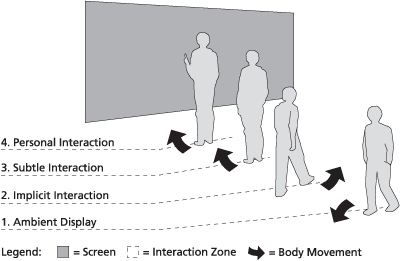

Figure 1: Perception and Usage of Interactive Displays
(Source: Daniel Michelis (2009), according to: Brignull & Rogers, 2003)
Monday, January 19, 2009
Touch Screen Interaction in Public Spaces: Room for Improvement if "Every Surface is to be a Computer"!
With Win7's "multi-touch" capabilities, Bill Gate's statement that every surface will be a computer might come true, but from what I can see, we have a long way to go before we get it right!
One of the concerns I have about "touch" screen interaction in public spaces is that not much thought is given to the environmental factors surrounding the system. The system that is tested for the first time after installation might work just fine, but not when it is put to use under a variety of conditions or situations.
EXAMPLES (I've recycled a few of these from previous posts.)


Below is a shot of my husband, trying to see what is on the screen. This photo shows exactly what the screen looked like at the time:

The next picture tells it all. You can see that there is some sort of alphabet on the right side of the screen, but the reflection of my husband is easier to see. We couldn't figure this one out.

The following clip demonstrates how environmental concerns, such as wind and "sideways" rain, can make an interactive display at a shopping center difficult to use. During this clip, you can hear me muttering about the difficulties I had interacting with the information on the touch-screen display. It is possible that the system wasn't working well because of the exposure to the elements.
In my opinion, an interactive wayfinding application should run on a larger display and support two or more people, since many hospital visitors often run in pairs or small groups.
Sunday, May 11, 2008
Urban Screens, Urban Interfaces, Digital Media, and the Arts in Social-Public Spaces

Technology-supported human-world interaction is the phrase I created to help me handle things conceptually, and serves as an umbrella that covers the things that interest me within this sphere.
I recently participated in the Games for Health Conference. Eric Walker, from Ominous Development, in his talk about the development of a one-switch game, discussed the idea that when we think about games, there are three main areas of focus. One is the how the game is played within the machine, system, or computer. One is how the game is played within the interface, and one is how the game is played in the mind.
If you think about multi-player games, a fourth dimension is added- the social context. Take this one step further, in the realm of pervasive gaming, including mixed/augmented reality games, a fifth dimension must also be considered, which includes space, place, and geo-location. How does that play out in the world? I'd like to share a bit of what I've come across so far:
08 Urban Screens: The potential of screens for urban society
- "URBAN SCREENS investigates how the currently commercial use of outdoor screens can be broadened with cultural content. We address cultural fields as digital media culture, urbanism, architecture and art. We want to network and sensitise all engaged parties for the possibilities of using the digital infrastructure for contributing to a lively urban society, binding the screens more to the communal context of the space and therefore creating local identity and engagement. The integration of the current information technologies support the development of a new integrated digital layer of the city in a complex merge of material and immaterial space that redefine the function of this growing infrastructure."
- "URBAN SCREENS defined as various kinds of dynamic digital displays and interfaces in urban space such as LED signs, plasma screens, projection boards, information terminals but also intelligent architectural surfaces being used in consideration of a well ballanced, sustainable urban society - Screens that support the idea of public space as space for creation and exchange of culture, strengthening a local economy and the formation of public sphere. Its digital nature makes these screening platforms an experimental visualisation zone on the threshold of virtual and urban public space." (Mirjam Struppek)
One company, Soda , is involved with emerging technologies that are used in public spaces: "Soda develops creative tools that help communities work, play, and learn together" .
The Soda team members come from both art and technical backgrounds. One of Soda's projects was "Energy", which was an external light installation at a school, consisting of 45 LED panels, distributed on a large structure, in view of the playground. The designs on each panel were created by students, and the software behind the displays incorporates video shot by the children, so the art can be easily changed.
Soda partnered with FutureLab to create Newtoon, a suite of web-enabled microgames and activities, designed to promote the learning of physics social way, played on mobile devices.
Case study of the Newtoon prototype
Urban Interfaces is a project of the Australasian CRC for Interaction Design, and builds upon the work of their previous Suburban Communities project.
- "Urban Interfaces: designs, develops and evaluates “unconventional” interfaces, such as interactive urban/public screens, and mobile and embedded content, to improve social, economic and environmental sustainability, researching appropriation (adoption and adaptation) and embodied interaction (in the moment and in the world) in master-planned and existing residential communities."
People from the Urban Interfaces project recently presented a public displays workshop at CHI 08: Designing and Evaluating Mobile Phone-Based Interactions with Public Displays . According to the workshop paper, the " program is developing Future Ethnography to combine social context approaches, particularly ethnography, with participatory design, and applying it to mobile-, embedded-, and WWW-based experiences."
The people involved in this project include Ian MacColl and Margot Brereton, from ACID/QUT, Matthew D'Souza, Andrew Dekker, Adam Postula, Fiona Redhead, from the University of Queensland, Mark Billinghurst, from HACID/HITlabNZ, Ingrid Richardson, from ACID/Murdoch University, and Montse Ros, from ACID/University of Wollongong.
Update:
I recently received a comment from Ori Inbar with a link to http://www.gamesalfresco.com/, which has a good review of the "top ten" devices for mobile augmented reality, also known as AR.
Another interesting post from Games Alfresco reviews "top ten" augmented reality demos that have the potential to change augmented reality gaming. Comogard, the author of this post, writes that AR "has the potential to do something that parents can't: free gamers from their couches and usher them into the real world, to play".
In my opinion, AR games, played on mobile devices that support new games for health and learning. With the influx of large interactive displays (or interactive whiteboards) in public gathering spaces, libraries, museums, and schools, there is a possibility that mobile AR can be played out on a variety of screens, large and small.

Some of the thought behind Microsoft's Surface came from the work of Shahram Izadi, now at Microsoft Research, Harry Brignull, now a user experience consultant at Madgex, and Yvonne Rogers, a professor of human-computer interaction at Open University, and others, on the Dynamo project.
(See my previous post- Revisiting Promising Projects: Dynamo- an application for sharing information on large interactive displays in public spaces.)


 For detailed information about the Dynomo project, read The Iterative Design and Study of a Large Display for Shared and Sociable Spaces (pdf).
Harry Brignull's blog post, "Microsoft Surface: standing on the shoulders of giants" , written on the day the Surface was unveiled to the public last year, also provides good background information related to this topic.
Back to the Urban Screens discussion:
First Monday, a peer-reviewed journal on the Internet, published a special issue, Urban Screens: Discovering the Potential of Outdoor Screens for Urban Society, in 2006. The articles were written by people from disciplines related to media and communications, so they provide a much broader perspective to the topic of large screen displays than found in journals published by the ACM or IEEE. (If you are a CS or IT academician involved in large display and/or ubiquitous computing research, this series is a must-read!)
Raina Kumra, in Hijacking the Urban Screen, discusses the use of non-traditional outdoor advertising, and looks at way this new "media skin" is responding to interaction, transforming the more traditional video billboard to something that is creative and invites public participation.
In Urban Screens: the beginning of a universal visual culture, Paul Marten Lester points to Otto Neurath's quote, "words divide, pictures unite". According to Lester, "Literal, narrative, horizontal, cloistered, and verbal culture is being replaced by symbolic, interactive, profound, global, and visual culture. Neurath would be pleased." Lester delves into the world of visual symbols, visual thinking, and visual communication. His reference list, for the academics out there, is full of gems!
Scott McQuire's article, The politics of public space in the media city, discusses the concept of hybrid spaces, or media cities, and his thoughts about access and interaction, and a "democratic public culture in cities connected by digital networks."
In The poetics of urban media surfaces, Lev Manovich discusses how technologies such as video surveillance, data-filled "cell-space", and electronic displays transform physical spaces into data-spaces (think "Internet of Things"). Included in his discussion is an outline of some of technological research related in some way to urban media surfaces: ubiquitous computing, augmented reality, tangible interfaces, wearable computers, intelligenct buildings, intelligent spaces, context-aware computing, ambient intelligence, smart objects, wireless location services, sensor networks, and e-paper.
I haven't finished reading all of the articles included in First Monday's special issue about urban screens. Listed below are the references and links for all of the articles, with links to many of the authors:
Hijacking the urban screen: Trends in outdoor advertising and predictions for the use of video art and urban screens by Raina Kumra First Monday, Special Issue #4: Urban Screens: Discovering the potential of outdoor screens for urban society (February 2006),URL: http://firstmonday.org/issues/special11_2/kumra/index.html
Urban Screens: the beginning of a universal visual culture by Paul Martin Lester First Monday, Special Issue #4: Urban Screens: Discovering the potential of outdoor screens for urban society (February 2006),URL: http://firstmonday.org/issues/special11_2/lester/index.html
The politics of public space in the media city by Scott McQuire First Monday, Special Issue #4: Urban Screens: Discovering the potential of outdoor screens for urban society (February 2006),URL: http://firstmonday.org/issues/special11_2/mcquire/index.html
The poetics of urban media surfaces by Lev Manovich First Monday, Special Issue #4: Urban Screens: Discovering the potential of outdoor screens for urban society (February 2006),URL: http://firstmonday.org/issues/special11_2/manovich/index.html
Interpreting urban screens by Anthony Auerbach First Monday, Special Issue #4: Urban Screens: Discovering the potential of outdoor screens for urban society (February 2006),URL: http://firstmonday.org/issues/special11_2/auerbach/index.html
Story space: A theoretical grounding for the new urban annotation by Rekha Murthy First Monday, Special Issue #4: Urban Screens: Discovering the potential of outdoor screens for urban society (February 2006),URL: http://firstmonday.org/issues/special11_2/murthy/index.html
The urban incubator: (De)constructive (re)presentation of heterotopian spatiality and virtual image(ries) by Wael Salah Fahmi First Monday, Special Issue #4: Urban Screens: Discovering the potential of outdoor screens for urban society (February 2006),URL: http://firstmonday.org/issues/special11_2/fahmi/index.html
Urban screens: Towards the convergence of architecture and audiovisual media by Tore Slaatta First Monday, Special Issue #4: Urban Screens: Discovering the potential of outdoor screens for urban society (February 2006),URL: http://firstmonday.org/issues/special11_2/slaatta/index.html
Towards an integrated architectural media space by Ava Fatah gen. SchieckFirst Monday, Special Issue #4: Urban Screens: Discovering the potential of outdoor screens for urban society (February 2006),URL: http://firstmonday.org/issues/special11_2/fatah/index.html
Art and social displays in the branding of the city: Token screens or opportunities for difference? by Julia Nevárez First Monday, Special Issue #4: Urban Screens: Discovering the potential of outdoor screens for urban society (February 2006),URL: http://firstmonday.org/issues/special11_2/nevarez/index.html
For an aesthetics of transmission by Giselle Beiguelman First Monday, Special Issue #4: Urban Screens: Discovering the potential of outdoor screens for urban society (February 2006),URL: http://firstmonday.org/issues/special11_2/beiguelman/index.html
Intelligent skin: Real virtual by Vera Bühlmann First Monday, Special Issue #4: Urban Screens: Discovering the potential of outdoor screens for urban society (February 2006),URL: http://firstmonday.org/issues/special11_2/buhlmann/index.html
Programming video art for urban screens in public space by Kate Taylor First Monday, Special Issue #4: Urban Screens: Discovering the potential of outdoor screens for urban society (February 2006),URL: http://firstmonday.org/issues/special11_2/taylor/index.html
Mirjam Struppek at Interaction Field: "Urban Space, Public Sphere, and the New Media"
Friday, February 22, 2008
Convergence: Digital Out of Home Experience, Marketing, Pervasive Computing...
It is interesting to see how various digital technology sectors are overlapping and converging as make attempts to expand their markets, improve education.or make a social impact.
One example of this convergence is described in a recent post in Future-Making Serious Games, by Eliane Alahdeff about Reatrix, a company that focuses on interactive digital OOH marketing and "brand play". 
Excerpt from the Reatrix website:
"The unique Reactrix advertising and entertainment experience leads to unsurpassed media effectiveness, made possible by proprietary reactive technology that projects vivid branded messages onto 6-foot by 8-foot surfaces. Images instantly respond to movement or gestures, creating a participatory media experience that allows brands to "come alive" and invites people to interact with them."
I haven't come across anything from Reactrix in the course of my daily life, but when I do, I'll be sure to have my video camera ready! I wouldn't want to be disappointed.
Note:
To get a better understanding of this phenomenon, do a search on the following terms or combination of terms:
Off-the-desktop, Internet tablets, interactive whiteboards, web-enabled cell phones, sensors, GPS, GIS, "digital-out-of- home" (Digital OOH),digital signage, interactive kiosks, advergaming, wayfinding, pathfinding, "in the wild", pervasive computing, ubiquitous computing, mobile, interactive, ambient, mScapes, serious games, social spaces, public places, networked real estate, touch screens, intelligent buildings, user-centered design, user-centered content, usability, user experience design, interaction design.




