Sunday, February 5, 2012
LINK LIST!
Jason Silva's multimedia review of ABUNDANCE. Exponential Technological Progress. Less than two minutes.
Interactive Technology: Take a look at Corning's "Day Made of Glass 2: Unpacked" Video!
Razorfish Gesture and Touch Platform for the "Retail Experience"
Flight of the Fireflies, an Interactive Musical Poem/Game for the iPad, by Woolly Robot (video trailer)
Google in Education, Updated
iBooks Textbooks for iPads, iTunesU App- and links to info about 1:1 iPad initiatives in public schools
Quick Post: Link to a UX Gold Mine-Official Usability, User Experience, and User Interface Guidelines from Companies
GeekDad's Post: The Changing Nature of App Design for Kids
How to use game dynamics in the classroom, with good links, via Edudemic (Jeff Dunn)
Immersive Learning for Math using DimensionU Games- new "Play, Learn and Earn" with an allowance component.
Off-topic: "Communication technology for human-dog interaction" and "The secret life of my dog: design and evaluation of a paw tracker concept"....and my dog.
You Know You've Secretly Wanted to Learn to Code! (Info, links, video)
3D Plug-in for SMARTBoard Notebook (Video)
"Kinect-based Telepresence with Room Sized 3D Capture and Life Sized Display, Includes Behind-the-Scene "how-to" (UNC Chapel Hill)
Near-Field Communication in Education? Arts? Wayfinding?
iPads for every student in an elementary school in NC, Smartboards in the classrooms, and one awesome principal
Christian Bannister's Interactive Multi-touch and Gesture-based Bubcycle Project. Use your hands to shape sound, create, and manipulate music. Wow!!
UPDATE: EIST Call for Papers/Presentations
Kinect in Education! (kinectEDucation)
Now You See It: How the Brain Science of Attention Will Transform the Way We Live, Work and Learn, an awesome book from Cathy "HASTAC" Davidson
Near Field Communication (NFC) for Smartphones at the Museum of Londun, related video, and NFC links.
Quick Link: The Remote - Death by Voice Control?
46 Seconds of Steve Job's Wisdom-Vision
MozoCam Video Demos: Great for virtual field trips, awesome HD + fluid movement
FlatFrog Multi-touch Videos: Point Separation, Multi-input, Multi-user input
Starbucks Cup Magic: Augmented Reality App for iPhone and Android!
Revisiting Good Blogs: User Interface Engineering (Albrecht Schmidt, University of Stuttgart)
Revisiting Good Blogs: Eager Eyes (Robert Kosara, UNC-Charlotte)
TWINE video and the Supermechanical Blog: Moving Towards the Web of People and Things!
Revisiting Good Blogs: Nathan Yau's FlowingData


Tuesday, April 19, 2011
Gesture + Multitouch Interactive Media Wall, Wisconsin Institutes for Discovery, 2011 Award of Excellence, Digital Screenmedia Association
Detailed information about the Discovery Wall, including an overview of the technology, objectives of the deployment, and the positive outcomes of his project can be found on the Digital Screenmedia website.
"Float4 Interactive is a creative technology company that develops interactive systems for entertainment, advertising and design applications."
Credits
Interactive technology: Float4 Interactive
Content: Zebra Dog
AV Integration: R2W
Concept: Sensory Interactive
DISCOVERY WALL: 10 X 4 Christie MicroTiles
5496 X 1650 resolution
Gesture + MultiTouch Interaction
2 X RealMotion Servers
ENTRANCE PORTAL 17 X 2 Christie MicroTiles
9824 X 866 resolution
Multi-Zone Gesture Interaction
2 X RealMotion Servers
RELATED/SOMEWHAT RELATED
Wisconsin Institutes for Discovery: 2011 Excellence Award, Architainment
Live Design, 3/21/10
Architainment Examples
Christie MicroTiles Drive Fan Experience at new Nascar Hall of Fame
Nascar Hall of Fame (I live in the Charlotte area, so I'll visit the Nascar Hall of Fame soon and check out the Christie MicroTiles display soon!)
Miami Dolphins Choose Montreal's Arsenal Media and Float4 Interactive for Fan-Focused Interactive Wall at SunLife Stadium (BuzzWall) Arsenal Media, 12/16/10
Sunday, April 3, 2011
Recent Interactive Multimedia Blog Post Links
Call for Papers: Touch the Web 2011: 2nd International Workshop on Web-Enabled Objects
Links: Web of Things, Web Patterns and the EPC Cloud, Windows 8 Rumors, Human Centered Service Design
Virtual History of Rome for the iPad, Created with Unity
Program - CHI 2011 Child Computer Interaction: 2nd Workshop on UI Technologies and Educational Pedagogy


FYI: If you are new to this blog, my main blog is Interactive Multimedia Technology (IMT). I update this blog with links to posts on the IMT blog every month or so. I will resume this blog in this once I reduce my current workload.
If you are interested in technology, psychology, and education, take a look at my TechPsych blog.
Tuesday, November 2, 2010
More links to posts, videos, and pics about interactivity, NUI, HCI, interactive infoviz, multitouch, UX...
Below are links to some of my recent posts about natural user interaction and interfaces (NUI), table-top and surface computing, human-computer interaction (HCI), user experience/ interaction design, educational technology, games, and more. Most of the posts contain pictures, videos, and/or interesting links.
EyeTube for YouTube! Eye-gaze interaction software, free and downloadable from GazeGroup
Open-source Eye-tracking: The ITU Gaze Tracker 2.0 Beta, Via Martin Tall, NUI Group Member
3D Browser-based Science Games from Muzzy Lane: T...
- Microsoft is acquiring Canesta, Inc., a developer ...
- Technology and Education, a Temporal Approach -Lin...
- Philipp Geist: Blending the Physical with the Dig...
- Interactive Timelines using Timemap.js (via O'Rei...
- Transmedia Storytelling, Interactive Multimedia, &...
- Augmented Reality Eyeglasses: I AM geeky enough to...
- Technology, Entertainment, Design, and More: Vide...
- TEDx Charlotte (NC) Videos
- SepiaTown: View and Share Mapped Historical Images...
- PRIVACY AND THE INTERNET: A HELPFUL VENN DIAGRAM v...
- Journalism in the Age of Data, by Geoff McGhee ".....
- Quick Link: 3M Invests in Perceptive Pixel, Jeff ...
- Screen Future: The Future of Entertainment, Comput...
- Emerging Interactive Ed. Tech: Classmate Assist an...
- FYI: Top Interactive Multimedia Technology blog po...
- End of GOOG-411, Google's "phoneme harvesting oper...
- "Out My Window", a web-based, interactive 360-degr...
- Information Visualization for the People: The End ...
- Words of Wisdom (and more) from Harry Brignull: U...
- Online Physics Games for Interactive Whiteboards a...
- In Honor of Benoit Mandelbrot: Fractals on the Web...
- Benoit Mandelbrot: A Patterned Way of Viewing Life...
- "Animate" Graphic Presentation: Sir Ken Robinson's...
- Oh! No! Sony's "Mother of Remote Controls" for Goo...
- Update on Josh Blake, newly designated Microsoft S...
- Power to the Pixel Cross-Media Forum Streaming Liv...
- Cool Sci/Tech News in my Local Paper! (Links, vide...
- Designing for Multitouch Tables and Surfaces, by E...
- Project: Interact "Invent, Design, Change" - A 10...
- Michael Ogawa, Data Visualization Researcher, VIDI...
- Interview of Gillian Hayes: Interactive Visual Supports...
- Reactable Mobile - Music Creation and DJ-ing On-th...
- Light Space: Interaction with digital content acr...
- Child-Computer Interaction: A Featured Community a...
Links to posts, videos, and pics related to interactivity and technology
Sunday, December 20, 2009
CityScape 1.8: What would it be like on an interactive touch/gesture screen or table?
Video, links, and pictures can be found on the following Interactive Multimedia Technology blogpost:
CityScape 1.8: What would it be like on an interactive touch/gesture screen or table?
Saturday, September 26, 2009
Near Field Communication Touch Interaction
From the Interactive Multimedia Technology blog:
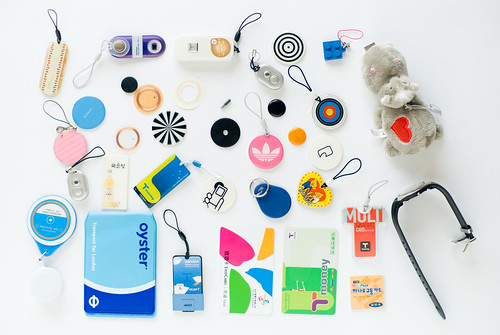
The Touch Project is based in the Interaction Design department of the Oslow School of Architecture and Design in Norway. "Touch is a research project that investigates Near Field Communication (NFC), a technology that enables connections between mobile phones and physical things. We are developing applications and services that enable people to interact with everyday objects and situations through their mobile devices. Touch consists of an inter-disciplinary team involved in social and cultural enquiry, interaction/industrial design, rapid prototyping, software, testing and exhibitions." -
Nearness Explores Interaction Without Touching
Nearness from timo on Vimeo.
iPhone RFID: Object-based media
iPhone RFID: object-based media from timo on Vimeo.

reTouch Info Sheet (pdf)
reTouch is part of the Touch project, and it " brings together hundreds of cross-cultural examples of social norms and values involving touch—all categorised according to actions related to touching. Using quotes from ethnographic accounts written between the late 1800s and the present, re/touch encourages designers and researchers to explore how touch is used by people to relate to one another and the worlds in which we live. Browse re/touch to create design briefs, refine interaction scenarios, devise game play, or otherwise think, make and do things touchrelated." -reTouch web info, Anne Galloway.
One of the members of the research team is Anne Galloway, a social researcher and the author of the purselipsquarejaw blog, which she recently resurrected after taking a year off from blogging.
Anne also contributes to the space and culture journal. I've followed Anne's writing for a while. Over the course of her Ph.D. studies, she has thought deeply about the intersections of technology, space, and culture, including cross-cultural meanings of touch.
RELATED
Inspiring Touch Related Interaction Design

Original Design Thinking Approach for Researching RFID
-Nikolas Nova, Pasta and Vinegar
Note: Nikolas Nova's Pasta and Vinegar blog is worth taking a look at if you are interested in design, UX, emerging technologies, pervasive/ubiquitous computing.
About Nikolas and his blog:
"User Experience researcher at LIFTlab. My work is about studying how people use various technologies and turn them into insights, ideas, prototypes or recommendations to inform design and foresight.This blog is a selection of the material that I collect, especially in fields such as mobility, urban environments, digital entertainment and new interfaces. I am also part of the near future laboratory."
Sample of Pasta and Vinegar Posts:
(Touch) Interaction Vocabulary
A Graphic Language for Touch-based Interactions
Natural User Interface News: Bamboo Wacom multi-touch gesture tablet; SnowFlake Suite and PresTop multi-touch kiosks
Cross-post:
Wacom Tablets Get Multi-Touch, Gestures
(Charlie Sorrel, Wired, 9/24/09)
"For the tech-curious, the new tablets have 512 pressure levels in the pen tip and the active area of the tablet is 5.8 x 3.6 inches, and all lose the in-pack mouse (for obvious reasons). The Touch and the Pen models are both $70, and the Pen & Touch is $100. Also, if you were thinking of buying Photoshop Elements 7 for the same price, get a tablet instead — Elements comes in the box."

Official Wacom Video
"Bamboo Touch is new type of computer input device by Wacom that lets you navigate and perform commands like zoom, scroll, rotate and more with a series of simple finger taps and hand gestures. Bamboo Touch brings Multi-Touch capability to your Mac or PC"
Video from a Wacom user:
A nice alternative to a mouse. I'm going to get one for my laptop!
Multi-touch Kiosks!
Press release: Dutch touchscreen supplier PresTop partners with Natural User Interface (NUITEQ)


RELATED
I couldn't find any video clips of PresTop's multi-touch interaction. From what I can tell, PresTop multi-touch screens will be using SnowFlake Suite from Natural User Interface Technogies AB.
How-to:SnowFlake Suite Flash multi-touch Interactable component (NUIversity)
Without a single line of code, you can do quite a bit with Snowflake Suite
"This video covers how to make a rotatable and scalable image. The beauty about this is, that we have developed a Flash mouse input simulator, so that there is no need for multi-touch hardware in order to develop your applications. Simply simulate multiple mouse inputs for multi-touch.This project is still in alpha phase and a download will become available with the next release of Snowflake Suite 1.7 for the NextWindow platform and camera based multi-touch solutions."
Below is a video of single-touch interaction for PresTop, from Omnivision:
PresTop PresTop offers interactive hardware and software solutions that can be used indoors as well as in outdoor environments.

Tuesday, July 14, 2009
Video Clip: Nokia's Study of Gestures Around the World (6th sense?)
The video explains it all.
The video is from the Nokia Conversations YouTube channel.
(Fritz Desir, thanks for the link!)
Sunday, February 8, 2009
Internet of People, Things, Surfaces, and Interactions: Insights from UX 2008 & Adaptive Path
Adaptive Path is a company full of forward-looking, creative people who focus on user experience, interaction design, and information architecture. It sponsors UX Week each year, which provides participants with a refreshing update on current trends in the field. The following videos are a sample of what was presented at UX 2008. I plan on updating this post soon with a few brief notes and comments.
If you are interested in learning more about all things related to UX, take some time to go through Adaptive Path's reading list!
Don Norman
Don Norman | UX Week 2008 | Adaptive Path from Adaptive Path on Vimeo.
Dennis Wixon
Dennis Wixon | UX Week 2008 | Adaptive Path from Adaptive Path on Vimeo.
Dan Saffer
Dan Saffer | UX Week 2008 | Adaptive Path from Adaptive Path on Vimeo.
Dave Wolf
Dave Wolf | UX Week 2008 | AdaptEDive Path from Adaptive Path on Vimeo.
Dave discusses his company's philosophy of software design process: "Right Software, Right Device, on the Right Area on the Network, or Not on the Network at All". He highlights how this philosophy was incorporated into his company's contribution, "Ben", to the Microsoft Phizz Pop Design Challenge competition. The visualization about on-line news is interesting, incorporating the little video comments, which enriches the understanding of commentary.
Tuesday, January 6, 2009
Why "new" ways of interaction?
Why "new" ways of interaction?
Jonathan Brill, of Point & Do, has several video clips that explain the basics of multi-touch and gesture interaction. He is currently leading a book study of Dan Saffer's "Designing Gestural Interfaces" and is one of a small (and growing) group of people who are looking at ways technology can support human interaction and activities in a more natural, enjoyable, and intuitive manner.
"Mouse-based thinking simply doesn't work here....WIMP best practices slow users down, confuse them, and make multi-touch applications difficult to learn...a new class of applications....make it easier for groups of users to interact with complex information.
In the video clip below, Brill discusses the need to escape from the WIMP mindset. (Windows, Icons, Mouse & Point, the current way most people interact with computers and related devices.)
Here is a transcript of key points from the video:
"It has been 25 years since the first rich multi-touch system was publicly shown. That's a lot of research for a shocking lack of progress. By contrast, 25 years after the demo of the mouse, GUI (graphical user interface)had evolved into Windows, MS Office, Mosaic, Lan, and the Apple Newton, the basis for today's business productivity tools."
"The mouse was successful because early engineers developed a simple, clear interaction framework that everyone could follow. It was called WIMP: Windows, Icons, Menus, & Pointers. WIMP worked. It was cool, and it increased usability and solved key technology issues of the day:"
- Windows were a way to manage content on small displays
- Icons were a space-efficient way to point and click on commands
- Menus hid irrelevant content
- Pointers visually tracked mouse interaction
"Multi-touch needs an analogue to WIMP that makes it easy to use, across platforms. At Point & Do, we think we've found it. It is what we call PATA:
Places
Lighting, focus, and depth, simplified searching and effecting hyperlinked content
Animation
Using animation to subtly demonstrate what applications do and how to use them is a better solution than using icons. Animations makes apps easier to learn.
Things
Back in the days of floppy disks, objects helped us organize our content. This limitation was forced by arcane technology, but it did have one huge advantage. We used our spatial memory to help us navigate content. Things will help us organize content and manipulate controllers across a growing variety of devices.
Auras
Auras will help us track what we are tracking and when an interaction has been successful."
Here are a few more videos from Jonathan Brill:
Multi-touch Design Techniques Part 1 of 3
Multi-touch Design Techniques Part 2 of 3
RELATED:
"Surface and Tangible Computing, and the "Small" Matter of People and Design" (pdf) -Bill Buxton, ISSCC 2008
Designing for Interaction -Dan Saffer
The Computer for the 21st Century Mark Weiser, Scientific American, 09, 1991
(Note: I read this article when I was on a plane from Charlotte to Detroit, years ago, and never forgot about it. If you are just beginning to learn about HCI or ubiquitous/pervasive computing, or off-the desktop interaction design or application development, it is well worth the read!)
Sunday, November 16, 2008
Interacting in the Funky Forest: OpenFrameworks, Multimedia, and Kids
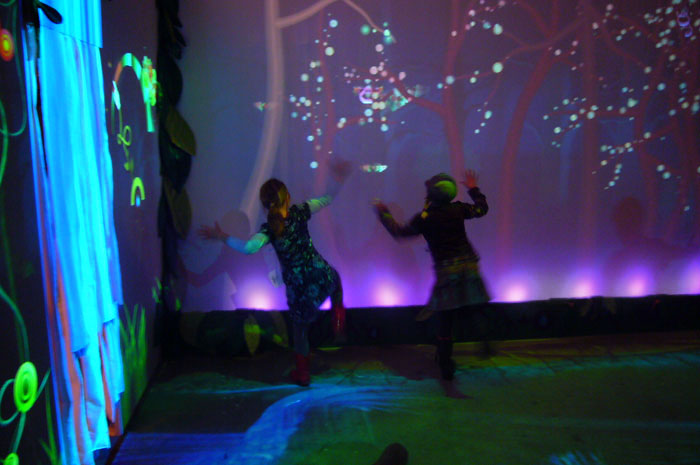

For more information about this installation, including a great video clip, please see OpenFrameworks & Interactive Multimedia: Funky Forest Installation for CineKid 2007
Funky Forest was created by Emily Gobeille and Theodore Watson.
Every Surface a Computer: "Scratch" - Capturing Finger Input on Surfaces using Sound. (Chris Harrison and Scott Hudson's Video - UIST '08)
Chris Harrison and Scott Hudson, from the Human-Computer Interaction Group at Carnegie-Mellon University, presented their latest research at the UIST '08 conference. Take a look at the video below to see how gestures that result in sounds can can transformed on unpowered finger input surfaces, using a stethoscope sensors and filters:
Yes, every surface is a computer!
(Even your pants...)
For detailed information, read the paper presented at UIST '08 by Chris Harrison and Scott E. Hudson:
Scratch Input: Creating Large, Inexpensive, Unpowered, and Mobile Finger Input Surfaces
RELATED:
The Best Paper Award at UIST '08 was "Bringing Physics to the Surface", by Andrew Wilson, of Microsoft Research, and Ahahram Izadi, Otmar Hilliges, Armando Garcia-Mendoza, and David Kirk, of Microsoft Research, Cambridge.
Here is the abstract:
"This paper explores the intersection of emerging surface technologies, capable of sensing multiple contacts and of-ten shape information, and advanced games physics engines. We define a technique for modeling the data sensed from such surfaces as input within a physics simulation. This affords the user the ability to interact with digital objects in ways analogous to manipulation of real objects. Our technique is capable of modeling both multiple contact points and more sophisticated shape information, such as the entire hand or other physical objects, and of mapping this user input to contact forces due to friction and collisions within the physics simulation. This enables a variety of fine-grained and casual interactions, supporting finger-based, whole-hand, and tangible input. We demonstrate how our technique can be used to add real-world dynamics to interactive surfaces such as a vision-based tabletop, creating a fluid and natural experience. Our approach hides from application developers many of the complexities inherent in using physics engines, allowing the creation of applications without preprogrammed interaction behavior or gesture recognition."
Preparation for the Internet of Surfaces & Things?
Thursday, November 6, 2008
Multi-touch, Gestures, Holograms, Oh My!
I've been posting quite a bit about emerging technologies lately on my Interactive Multimedia Technology blog, with lots of photos and video clips. Why? There has been quite a surge lately as new technologies move mainstream, much to my delight.
Microsoft's next operating system, Windows 7, allows for multi-touch and gesture recognition, and with this support, developers and harddware manufacturers are moving ahead. PDC 2008 (Professional Developer's Conference) and WinHEC 2008 (Windows Hardware Engineering Conference) included lots of multi-touch and gesture-based demonstrations. At the same time, CNN's multi-touch magic map wall gained more recognition during a Saturday Night Live parody by Fred Armisen. CNN took emerging technology to the masses on election night via video holograms.
Here are links to some of my recent posts:
Multi-Touch News from WinHEC and PDC
CNN's Holographic Technology: Wolf Blitzer and Jessica Yellin, Anderson Cooper and Will.I.Am, and the Music Video
Searching for Multi-Touch Info? Drivers for Windows 7 available from NextWindow &HP TouchSmart... More about N-Trig....Multi-Touch Resources
Emerging Technologies: SHiFT 08 Conference- Sensor Networks and Data for the Open Internet of Things
Emerging Interactive Technologies: SecondLight from Microsoft, at PDC 2008
Steven Sinofsky Discusses Multi-touch and the HP TouchSmart, Windows 7, and more at PDC 2008
Grafiti - a multi-touch, table-top, surface computing application, from a member of the NUI group
Multi-touch Parody of CNN's Magic Map Wall: Saturday Night Live's Weekend Update MegaPixel Giant Touch-map
The atracTable Multi-Touch System from Atracsys
Most of my October blog posts
Saturday, July 19, 2008
Resources for Multi-touch, Gesture Interaction , and Surface Computing (and thoughts about how this might impact computer science instruction)
Looking for more information about multi-touch, gesture interaction, and surface computing?
Here are a couple of links:
- Post highlighting Harry van der Veen, from Natural User Interface Europe AB, with a link to a video presentation of his overview of multi-touch technologies and gesture interactions. The post contains several related links, including presentations about interaction and new technogies from the recent Business to Buttons conference.
- Post by "tony", on the Computer Science Canada blog, about the use of vvvv and the development of an intelligent tracking system. Although the post was written a while ago, it contains some good links. The CompSci.Ca/blog contains a wealth of information useful to students and people who work in computer science and related fields.
This got me thinking a bit. How will this sort of programming impact what is taught in high school and university computer courses? Keeping Students Interested in Computer Science is a must-read for computer science teachers and those of you who are concerned about the decline in the numbers of students pursuing further education in computer science and related fields.
I found the post on the CompSci.Ca blog. The author, Clayton Shier, is a high school student who has more than few words of wisdom about this topic.
The discussion generated by Clayton's post is worth the time exploring. I thought this comment to Clayton's post was especially interesting:
"My teacher though is a boring fellow too, and I’m not sure he’s completely up on programming. He’s not as bad as the stereotypical Computer Science teacher, but still not the best either. I was talking to him the other day, and I mentioned something about design patterns, and he said he didn’t know what I was talking about."
These high school students are probably ready to learn about programming for multi-touch applications and other emerging technologies, and others with no previous programming experience might be enticed to stay in their courses if the curriculum was meaningful. We can't afford to lose them.
If high school computer science teachers aren't up-to-date with traditional programming methods, they are not likely to explore programming methods for emerging technologies. How does this bode for the future?!




