Monday, December 24, 2012
Merry Linkfest!
Enjoy!


Thursday, November 24, 2011
Update: Links from Interactive Multimedia Technology!
Mind/Shift Blog Post: Read, Hear or Create a Story: Apps for Traveling with Kids - and great related links!
Camera-less Tabletop Computing with Samsung SUR40 for Microsoft Surface with PixelSense
Is the answer Voronoi? Looking for possible solutions to an art+dance+music+tech idea from a recurring dream.
Art+Tech: The work of Aparna Rao and Soren Pors - a TedTalk worth watching!
Revisiting Good Blogs: IDEUM update
Link to a great rant about interaction design. It is all about the hands, screens and surfaces, not so much!?
Revisiting Good Blogs - Web of Things: "Architecting the Web of Things for Tinkerers and Hackers"
Visiting New (to me) Blogs: Learning WebGL
Revisiting Good Blogs: Space and Culture
Quick Link: 68 interesting ways to use an iPad in education
Building Interfaces for the New Decade
Google Chrome Web Store!
Le Chal: Smart shoes for the Visually Impaired
Call for Papers: Educational Interfaces, Software, and Technology, a workshop at CHI 2012
Interactive Large Displays in Urban Spaces: Communicating Energy Usage through Duke Energy's "Smart Energy Now" Project
Quick Link: iPads and Autism - 60 Minutes Segment
What would it be like if pens were "banned" from classrooms every Wednesday? Video clip by Mick Waters, not just for teachers and students!
Make and Share Your Games Online! Update: Game Creator and the Cartoon Network Website
T(ether): Next-Gen Data Gloves + iPad: Just what I needed for the colder weather!
Google Labs RIP
RENCI Update: Combining Gaming and Visualization
Hacking Autism: Touch Technology for Young People with Autism Spectrum Disorders
Stantum's Multi-Modal, Multi-Touch Technology: Looks Great for 21st Century Learners; Supports Creative, Collaboraitve Knowledge-Sharing
Sunday, September 20, 2009
Interactive interfaces at the Gray Area Foundation for the Arts
This video gives some background about the Gray Area Foundation for the Arts, and also provides a glimpse of some interesting interfaces and interaction.
forward/slash: The Gray Area Foundation for the Arts Story from GAFFTA on Vimeo.
"Gray Area Foundation for the Arts (GAFFTA) is a San Francisco-based nonprofit dedicated to building social consciousness through digital culture. Guided by the principles of openness, collaboration, and resource sharing, our programs promote creativity at the intersection of art, design, sound, and technology. By making digital culture accessible, substantive and inspiring, we aim to help realize the greatest power of technology: to bring us closer, faster. For more information and how you can be a part of our vision, please visit gaffta.org"
Thanks to Seth Sandler for the link!
(This is a cross-post.)
Tuesday, August 4, 2009
Revisiting Urban Screens: 555 Kubik Facade Projection Video; info about media facades...
555 KUBIK | facade projection | from urbanscreen on Vimeo.
Take a look at the Urban Screen video channel on Vimeo!
About Urban Screens.com (Germany):
"On one hand urbanscreen is a group of free media artists and architects, dealing with research and development of experimental media installations with the aim to stage urban areas. On the other hand urbanscreen acts as a professional agency which translates the creative potential of this current art form onto the dialogue between commerce and art.
"We are interested in getting in touch with anyone working in the field of experimental motion graphics and new media art to establish interesting cooperations as well as getting new inspiration. Please contact us with any question or idea."
For more background information about this concept, read my previous related to Urban Screens.
Additional information about the Urban Screen movement can also be found on the Urban Screens.org website:
"URBAN SCREENS investigates how the currently commercial use of outdoor screens and related infrastructure for digital moving images in urban space can be broadened with cultural content. We address cultural fields as digital media culture, urbanism, architecture and art. We want to network and sensitise all engaged parties for the possibilities of using the digital infrastructure for contributing to a lively urban society, binding the screens more to the communal context of the space and therefore creating local identity and engagement. The integration of the current information technologies support the development of a new integrated digital layer of the city in a complex merge of material and immaterial space that redefine the function of this growing infrastructure of digital moving images."
Here is the International Urban Screens Association (IUSA) spin on Urban Screens:
"Urban Screens are dynamic digital displays and visual interfaces located within urban public spaces. They include LED screens and signs, plasma screens, information terminals and projection surfaces as well as intelligent architectural surfaces and media facades."
"Urban Screens transform the capacity of public spaces to serve as a platform for user-generated civic and cultural expression, community building, multiculturalism and public engagement in issues related to social, cultural and environmental sustainability."
"Through networking, content sharing and joint broadcasting, they constitute a rapidly expanding and still largely experimental global multimedia infrastructure for commercial and cultural exchange"
"The IUSA aims to inform and support the ‘worldwide Urban Screens movement’: the expanding use of dynamic digital displays in public spaces; their considerate and sustainable integration in the urban landscape; and the ability for screen communities to collaborate in the digital space to share content, experience, ideas, innovations and emerging possibilities." -IUSA
RELATED:

Friday, April 17, 2009
Daniel Michelis: Interactive Displays in Public Spaces Blog
Daniel Michelis recently completed his Ph.D. dissertation on a topic that is dear to my heart. Information about his research can be found on his Interactive Displays in Public Spaces blog.
Here are links to a few of his posts:
Interactive Displays: Perception, Awareness, and Interaction
Evaluating Interaction with Display Applications in Public Space
I especially like the diagrams Daniel uses to depict zones of interaction:
Figure 3: Four-phase Model
(Source: Daniel Michelis (2009), according to: Vogel and Balakrishnan, 2004)
(Author: Daniel Michelis, Institute for Media and Communications Management, University of St. Gallen)
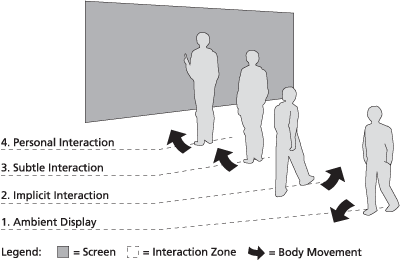

Figure 1: Perception and Usage of Interactive Displays
(Source: Daniel Michelis (2009), according to: Brignull & Rogers, 2003)
Monday, October 27, 2008
Media Facades Festival, Berlin October 16 through December 12, 2008

Here is the link:
Media Facades Festival Berlin 2008: Myths and Potentials of Media Architecture and Urban Screens"The MEDIA FACADES FESTIVAL BERLIN 2008 is an innovative project, engaging a wide range of stakeholders with distinctive interests in the public space. Through round tables, a workshop, panel sessions, lectures, urban screenings on media facades and an architecture exhibition the event will promote a multi-disciplinary action research approach to technology, architecture and media art in modern cities."
"Media façades can combine aspects of lighting and graphics in formats determined by the architecture, these might differ fundamentally in format, resolution and dimension from the rectilinear media image. Moving imagery has increasingly become interactive and emergent and often have to work without sound, so they question narrative storytelling known from other traditional media. Content can be synthesised from or driven by information from the environment, whether it be from within the building or from the outside world, or through channels such as the internet.
In connection with locative and mobile media, new forms of content production can develop that create through participatory approaches new relations between the imagery and the surrounding urban space and its citizen." - from the introduction
Pictures from the Media Facades Festival Site and other related pictures from Media Architecture:


Sunday, May 11, 2008
Urban Screens, Urban Interfaces, Digital Media, and the Arts in Social-Public Spaces

Technology-supported human-world interaction is the phrase I created to help me handle things conceptually, and serves as an umbrella that covers the things that interest me within this sphere.
I recently participated in the Games for Health Conference. Eric Walker, from Ominous Development, in his talk about the development of a one-switch game, discussed the idea that when we think about games, there are three main areas of focus. One is the how the game is played within the machine, system, or computer. One is how the game is played within the interface, and one is how the game is played in the mind.
If you think about multi-player games, a fourth dimension is added- the social context. Take this one step further, in the realm of pervasive gaming, including mixed/augmented reality games, a fifth dimension must also be considered, which includes space, place, and geo-location. How does that play out in the world? I'd like to share a bit of what I've come across so far:
08 Urban Screens: The potential of screens for urban society
- "URBAN SCREENS investigates how the currently commercial use of outdoor screens can be broadened with cultural content. We address cultural fields as digital media culture, urbanism, architecture and art. We want to network and sensitise all engaged parties for the possibilities of using the digital infrastructure for contributing to a lively urban society, binding the screens more to the communal context of the space and therefore creating local identity and engagement. The integration of the current information technologies support the development of a new integrated digital layer of the city in a complex merge of material and immaterial space that redefine the function of this growing infrastructure."
- "URBAN SCREENS defined as various kinds of dynamic digital displays and interfaces in urban space such as LED signs, plasma screens, projection boards, information terminals but also intelligent architectural surfaces being used in consideration of a well ballanced, sustainable urban society - Screens that support the idea of public space as space for creation and exchange of culture, strengthening a local economy and the formation of public sphere. Its digital nature makes these screening platforms an experimental visualisation zone on the threshold of virtual and urban public space." (Mirjam Struppek)
One company, Soda , is involved with emerging technologies that are used in public spaces: "Soda develops creative tools that help communities work, play, and learn together" .
The Soda team members come from both art and technical backgrounds. One of Soda's projects was "Energy", which was an external light installation at a school, consisting of 45 LED panels, distributed on a large structure, in view of the playground. The designs on each panel were created by students, and the software behind the displays incorporates video shot by the children, so the art can be easily changed.
Soda partnered with FutureLab to create Newtoon, a suite of web-enabled microgames and activities, designed to promote the learning of physics social way, played on mobile devices.
Case study of the Newtoon prototype
Urban Interfaces is a project of the Australasian CRC for Interaction Design, and builds upon the work of their previous Suburban Communities project.
- "Urban Interfaces: designs, develops and evaluates “unconventional” interfaces, such as interactive urban/public screens, and mobile and embedded content, to improve social, economic and environmental sustainability, researching appropriation (adoption and adaptation) and embodied interaction (in the moment and in the world) in master-planned and existing residential communities."
People from the Urban Interfaces project recently presented a public displays workshop at CHI 08: Designing and Evaluating Mobile Phone-Based Interactions with Public Displays . According to the workshop paper, the " program is developing Future Ethnography to combine social context approaches, particularly ethnography, with participatory design, and applying it to mobile-, embedded-, and WWW-based experiences."
The people involved in this project include Ian MacColl and Margot Brereton, from ACID/QUT, Matthew D'Souza, Andrew Dekker, Adam Postula, Fiona Redhead, from the University of Queensland, Mark Billinghurst, from HACID/HITlabNZ, Ingrid Richardson, from ACID/Murdoch University, and Montse Ros, from ACID/University of Wollongong.
Update:
I recently received a comment from Ori Inbar with a link to http://www.gamesalfresco.com/, which has a good review of the "top ten" devices for mobile augmented reality, also known as AR.
Another interesting post from Games Alfresco reviews "top ten" augmented reality demos that have the potential to change augmented reality gaming. Comogard, the author of this post, writes that AR "has the potential to do something that parents can't: free gamers from their couches and usher them into the real world, to play".
In my opinion, AR games, played on mobile devices that support new games for health and learning. With the influx of large interactive displays (or interactive whiteboards) in public gathering spaces, libraries, museums, and schools, there is a possibility that mobile AR can be played out on a variety of screens, large and small.

Some of the thought behind Microsoft's Surface came from the work of Shahram Izadi, now at Microsoft Research, Harry Brignull, now a user experience consultant at Madgex, and Yvonne Rogers, a professor of human-computer interaction at Open University, and others, on the Dynamo project.
(See my previous post- Revisiting Promising Projects: Dynamo- an application for sharing information on large interactive displays in public spaces.)


 For detailed information about the Dynomo project, read The Iterative Design and Study of a Large Display for Shared and Sociable Spaces (pdf).
Harry Brignull's blog post, "Microsoft Surface: standing on the shoulders of giants" , written on the day the Surface was unveiled to the public last year, also provides good background information related to this topic.
Back to the Urban Screens discussion:
First Monday, a peer-reviewed journal on the Internet, published a special issue, Urban Screens: Discovering the Potential of Outdoor Screens for Urban Society, in 2006. The articles were written by people from disciplines related to media and communications, so they provide a much broader perspective to the topic of large screen displays than found in journals published by the ACM or IEEE. (If you are a CS or IT academician involved in large display and/or ubiquitous computing research, this series is a must-read!)
Raina Kumra, in Hijacking the Urban Screen, discusses the use of non-traditional outdoor advertising, and looks at way this new "media skin" is responding to interaction, transforming the more traditional video billboard to something that is creative and invites public participation.
In Urban Screens: the beginning of a universal visual culture, Paul Marten Lester points to Otto Neurath's quote, "words divide, pictures unite". According to Lester, "Literal, narrative, horizontal, cloistered, and verbal culture is being replaced by symbolic, interactive, profound, global, and visual culture. Neurath would be pleased." Lester delves into the world of visual symbols, visual thinking, and visual communication. His reference list, for the academics out there, is full of gems!
Scott McQuire's article, The politics of public space in the media city, discusses the concept of hybrid spaces, or media cities, and his thoughts about access and interaction, and a "democratic public culture in cities connected by digital networks."
In The poetics of urban media surfaces, Lev Manovich discusses how technologies such as video surveillance, data-filled "cell-space", and electronic displays transform physical spaces into data-spaces (think "Internet of Things"). Included in his discussion is an outline of some of technological research related in some way to urban media surfaces: ubiquitous computing, augmented reality, tangible interfaces, wearable computers, intelligenct buildings, intelligent spaces, context-aware computing, ambient intelligence, smart objects, wireless location services, sensor networks, and e-paper.
I haven't finished reading all of the articles included in First Monday's special issue about urban screens. Listed below are the references and links for all of the articles, with links to many of the authors:
Hijacking the urban screen: Trends in outdoor advertising and predictions for the use of video art and urban screens by Raina Kumra First Monday, Special Issue #4: Urban Screens: Discovering the potential of outdoor screens for urban society (February 2006),URL: http://firstmonday.org/issues/special11_2/kumra/index.html
Urban Screens: the beginning of a universal visual culture by Paul Martin Lester First Monday, Special Issue #4: Urban Screens: Discovering the potential of outdoor screens for urban society (February 2006),URL: http://firstmonday.org/issues/special11_2/lester/index.html
The politics of public space in the media city by Scott McQuire First Monday, Special Issue #4: Urban Screens: Discovering the potential of outdoor screens for urban society (February 2006),URL: http://firstmonday.org/issues/special11_2/mcquire/index.html
The poetics of urban media surfaces by Lev Manovich First Monday, Special Issue #4: Urban Screens: Discovering the potential of outdoor screens for urban society (February 2006),URL: http://firstmonday.org/issues/special11_2/manovich/index.html
Interpreting urban screens by Anthony Auerbach First Monday, Special Issue #4: Urban Screens: Discovering the potential of outdoor screens for urban society (February 2006),URL: http://firstmonday.org/issues/special11_2/auerbach/index.html
Story space: A theoretical grounding for the new urban annotation by Rekha Murthy First Monday, Special Issue #4: Urban Screens: Discovering the potential of outdoor screens for urban society (February 2006),URL: http://firstmonday.org/issues/special11_2/murthy/index.html
The urban incubator: (De)constructive (re)presentation of heterotopian spatiality and virtual image(ries) by Wael Salah Fahmi First Monday, Special Issue #4: Urban Screens: Discovering the potential of outdoor screens for urban society (February 2006),URL: http://firstmonday.org/issues/special11_2/fahmi/index.html
Urban screens: Towards the convergence of architecture and audiovisual media by Tore Slaatta First Monday, Special Issue #4: Urban Screens: Discovering the potential of outdoor screens for urban society (February 2006),URL: http://firstmonday.org/issues/special11_2/slaatta/index.html
Towards an integrated architectural media space by Ava Fatah gen. SchieckFirst Monday, Special Issue #4: Urban Screens: Discovering the potential of outdoor screens for urban society (February 2006),URL: http://firstmonday.org/issues/special11_2/fatah/index.html
Art and social displays in the branding of the city: Token screens or opportunities for difference? by Julia Nevárez First Monday, Special Issue #4: Urban Screens: Discovering the potential of outdoor screens for urban society (February 2006),URL: http://firstmonday.org/issues/special11_2/nevarez/index.html
For an aesthetics of transmission by Giselle Beiguelman First Monday, Special Issue #4: Urban Screens: Discovering the potential of outdoor screens for urban society (February 2006),URL: http://firstmonday.org/issues/special11_2/beiguelman/index.html
Intelligent skin: Real virtual by Vera Bühlmann First Monday, Special Issue #4: Urban Screens: Discovering the potential of outdoor screens for urban society (February 2006),URL: http://firstmonday.org/issues/special11_2/buhlmann/index.html
Programming video art for urban screens in public space by Kate Taylor First Monday, Special Issue #4: Urban Screens: Discovering the potential of outdoor screens for urban society (February 2006),URL: http://firstmonday.org/issues/special11_2/taylor/index.html
Mirjam Struppek at Interaction Field: "Urban Space, Public Sphere, and the New Media"




