Friday, June 25, 2010
10 Interactive User Interfaces for the Future, Via Gizmo Watch; CNN's Eatocracy Site for Foodies - Food with Stories
I changed the name of this blog to reflect my focus on interactivity. The World Is My Interface is now The World Is My Interactive Interface.
In keeping with the change-of-blog-title, I thought I'd share a quick link to a recent Gizmowatch post, Ten Interactive User Interfaces for the Future. Bharat, the authro, reviews a variety of interfaces, input methods, and interaction techniques, such as Skinput, a water-based touch screen, a muscle-computer interface, air gestures, brain-computer systems, and even a mud-tub interface.
I was fortunate to see some of these interaction techniques and interfaces when I attended CHI 2010 this past April, and plan to share some of my photos and video clips on this blog soon.
Totally Unrelated
Online connection for foodies
Eatocracy is a new website within the CNN pages that provides news- and more- about all things related to food. The categories on the site include "main", "news", "bite", "sip", "make", "think", and "buzz". The best part, in my opinion, is the heirloom recipe collection index, where people can upload and share family recipies and the stories behind them.

Here is the description of Eatocracy from the website:
Eatocracy "is your online home for smart, passionate conversation and information about food news, politics, culture. We'll highlight regional and family recipes, dive into restaurants and food shopping, chat with celebrity and local chefs, and show you what's for dinner around the world tonight. Grab a place at the table and read with your mouth full."
Enjoy!


Sunday, November 2, 2008
The Internet of Things: More from CNN -Internetting every thing, everywhere, all the time; Sensor networks for the elderly
The Internet of Things has gone mainstream.
Yesterday I posted about David Orban's recent presentation at SHiFT 08: Sensor Networks and Data for the Open Internet of Things, and embeded the video clip, "Why We Need to Listen to our Things". I planned on revisiting this topic in a couple of weeks, but this morning, I came across two related articles that I wanted to share right away.
The first article, Internetting everything, everywhere, all the time, by Cherise Fong, for CNN, discusses the basics, and includes links to additional information about concepts, such as RFID, or Radio Frequency Identity technology, NFC (Near Field Communication), Spime, Nabaztag, Oyster, Octopus, Suica, Mirror, Tikitag, Violet, Mir:ror, ztamps - with links for the tech-curious.
What interested me the most was EEML, or Extended Environments Markup Language, which is "a protocol for sharing sensor data between remote responsive environments, both physical and virtual. It can be used to facilitate direct connections between any two environments; it can also be used to facilitate many-to-many connections as implemented by the web service Pachube, which enables people to tag and share real time sensor data from objects, devices and spaces around the world....Possible end-users range from construction managers, large-building occupants and architects, to electronics manufacturers and interactive artists and designers."
I came across the second related article in this morning's Sunday paper. The Charlotte Observer printed an article by Bob Moos, of the Dallas Observer, about the use of emerging technologies to help the elderly stay in their homes:
Robots, sensors to help elderly stay at home: Devices will detect when residents have sleepless nights or forget to take their medication

Photo via the Charlotte Observer, by Michael Mulvey - MCT Photo
Note: The system is running on Debian
The National Science Foundation and other sources have worked to fund the Heracleia Human-Centered Computing Laboratory at the University of Texas at Arlington. One of the focus of current research is to develop "smart" homes that are embedded with networks of sensors and webcams to support the independence of elderly people, without seeming like the system is an invasion of privacy. This technology, as well as related technologies, will be demonstrated at the Silvers Summit on Saturday, January 10, 2009 at the International Consumer Electronics Show (CES).
Related:
SmartSilvers Alliance
More about David Orban and OpenSpime:
If you are interested in emerging technologies and pervasive computing, you'll find Orban's blog facinating. It is published in English, Italian, and Hungarian. He's involved in several Web 2.0 communities, including Second Life. He is also a member of OpenSpime, where you can read his post that covers the topics in his SHiFT '08 presentation.
Listening to our objects (10/27/08)
Excerpt from post:
"The granularity, frequency, and intensity of the chatter that the spimes in the network perform will be vital, and it will be a fundamental task to be able and reliably translate from their plane of communication to the one of aggregated, second-order knowledge, where we can understand it, where we can derive useful, valuable information which we can act upon!"
OpenSpime:
"OpenSpime is a project of WideTag, Inc., a technology infrastructure company incorporated in California, USA, providing hardware and software solutions for an Open Internet of Things."
"The OpenSpime technology enables individuals, corporations, and governments to better understand the environment surrounding them. A new generation of GPS-enabled sensor networks, based on the open source OpenSpime communication protocol will collect the necessary data, and using scalable server technology, aggreate, manage, and visualize the data collected."

Snail Mail: RFID-enabled real snail, carrying e-mail.
"Our snails are equipped with a miniaturised electronic circuit and antenna, enabling them to be assigned messages. Your message is collected from a despatch centre at one end of their enclosure. Once associated with the tiny electronic chip on the snail's shell your message will be carried around until the snail chances by the drop off point. Here more hardware collects your message and forwards it to its final destination."
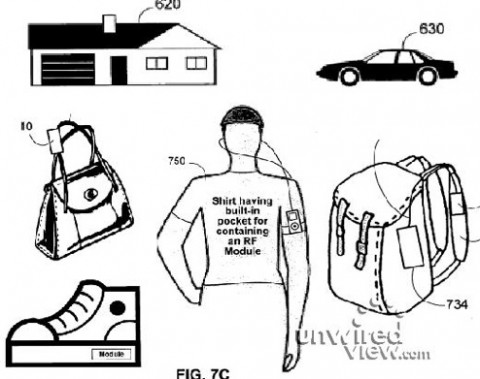
Apple's Personal Area Network Systems and Devices patent via SlashGear
IPSO Alliance: Promoting the use of IP for Smart Objects: "Welcome to the launch of the Internet of Things"
"Today, with this association, we are creating the foundation which makes the Internet of Things a reality. We are bringing together companies across the globe with the objective of using IP to interconnect physical objects with the global Internet. Through our Technical Advisory Board we will document, demonstrate and teach how IP can be used in Smart Objects and provide IPSO members with updates on technology standards. This IP Smart Object technology will play an essential role in the challenge to master our energy distribution and consumption, automate our homes and work environments, modernize our cities and satisfy many other market requirements" -Geof Mulligan, Chairman; Patrick Wetterwald, President, JP Vasseur, TAB Chairman
IPSO Alliance FAQ's
RFID Weblog
Ann Galloway's Internet of Things Working Bibliography
Privacy and Security Issues, RFID, and the Internet of Things
As RFID tracking booms, privacy issues loom (Chris Taylor, CNN, 5/11/07)
Saturday, October 25, 2008
SNL's Multi-touch Parody of CNN's Interactive Touch Screen Magic Map Wall
Via Interactive Multimedia Technology
Most viewers familiar with CNN news know about the "Multi-Touch Collaboration Wall", or Magic Wall, used by John King. David Borhman, a CNN producer, was describes the purpose of the Magic Wall in a quote in a Washington Post article:
"It's a stupendous way to explain a lot of complicated data"..."Fundamentally, our job is to explain things to people, and we need it visually. This lets us do it naturally, without a keyboard or mouse getting in the way....Once you see it, you get it instantly."
This would be fun to play with- for just about everyone! If you don't have ready access to a "magic wall", take a look Fred Armisen's playfulness in a recent Saturday Night Live parody of the CNN Magic wall:
Video clip via Hulu
Partial Transcript:
"One thing we are going to look at is Pennsylvania..Have a very good look at Harrisburg.....Get in really close to this. Back a bit, back a little bit, excellent"
"Now the country can be moved up and down, like so....We can also shrink it and put it in your pocket if you need to."
"You can always change the colors. You got blue, blue again, a little bit of red...right over there, a little bit of blue of course, if you want to make something out of green, you got a little face there, some whiskers, we can ..... make a cat. Notice the triangle nose!"
"Let's look at Ohio. Lets look at the Cleveland area. Lets look really really close. Really close. Really really close, You can see the top of a warehouse. We're really going to want look at that. Very, very important, were going to want to look at that."
"You can take Oregon, lets move it out into the ocean. It will be completely surrounded by water. That's very, very dangerous."
"And here is New York.... New York was there in 2004, and you can shake it around like that.. (shakes New York)"
"Actually, what I'm doing is very important, and informational"
"OK, Fred, stop goofing around..."
Fred turns to the map, and with both hands, moves all of the states out of place.
Photo via engadget
"Check out Michigan... I can make it bounce!" (Drags down Michigan on the map, it bounces up and down once it reaches the bottom of the map.)
Rumor has it that Jeff Hans, of Perceptive Pixel, was responsible for the SNL version of the Magic Touch-Wall map.




