Friday, February 20, 2009
User Experience and IKEA

I wrote about IKEA's interactive website in a previous post, before the new IKEA store opened in my area, and since then, I counted the days until it opened.
The grand opening was this week, and I went shopping there last night with one of my daughters.
I ate the Swedish meatballs in the cafeteria. I wanted to buy things.
We decided that IKEA uses some sort of aroma-therapy/mind control through out the store.
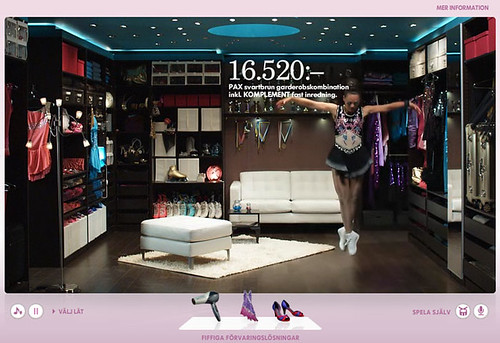
This was my first visit to an IKEA, and it was awesome. They had flat-panel televisions all over the place. I was hoping that one of the displays would be connected to that cute IKEA website, KOM IN I GARDEROBEN. The English version: Come Into the Closet.
It would have been fun to control the dancers while sitting on a showroom sofa, using gestures.
From the IKEA Website:
"This is a campaign to promote IKEA's wardrobe solutions. IKEA wanted to show their huge range of styles and all the smart features on the inside....All the movements on the web site are controlled by sound and music.So change songs, upload your own music, play on your keyboard or sing into the microphone."
For more details:IKEA's Interactive Dancing and Musical Website
Enjoy the site!


Monday, January 5, 2009
IKEA's Interactive Dancing and Musical Website "Welcome to the Closet", via Kinetic Interface (cross-post )
Doug Fox, of the Kinetic Interface blog (part of Great Dance), shared IKEA's new promotional site that allows for tons of multimedia interaction. The website features a series of rooms to highlight various products.
Visit Come into the Closet!
IKEA Interactive Multimedia Game
Unlike most static, or even flash-based websites, the user has control over many dimensions of experience:
- Simply watch the dancers and listen to the music, navigating from room to room
- Control the dancers by tapping on your computer's keyboard
- Control the dancers by clapping, singing, or making other noises
- Combine tapping your keys while watching and listening
- Upload your own Mp3's and watch the dancers dance
Here is a video preview of some of the dance interaction in the site:


Duncan, of the Inspiration Room, also posted credit information regarding the IKEA website:
The following credits were posted by Duncan on the Inspiration Room Daily:
"The site was developed at Forsman Bodenfors, Sweden by web director Mathias Appelblad, copywriter Fredrik Jansson, art director Anders Eklind, designers Anton Robsarve and Christoffer Persson, agency producers Peter Gaudiano, Charlotte Most, Asa Jansson, account director Philip Mascher."
"An earlier version of the site was developed in 2006, winning a Yellow Pencil at the DandDs, and can be viewed online at Forsman Bodenfors."
"Web development was done at Kokokaka, Gothenburg."
"Filming was shot by director Amir Chamdin via Chamdin & Stöhr, Stockholm, with director of photography Gosta Reiland."
"Music is by Dead Mono."
Cross-posted from the Interactive Multimedia Technology blog.
Sunday, January 4, 2009
Screens of All Sizes: Nielson Wire Report: Television, Internet and Mobile Usage in the US (3rd Quarter 2008)
Those of you who regularly follow this blog know that I'm obsessed with off-the desktop technology, including screens of all sizes, used in various situations and settings. On this blog, as well as the Interactive Multimedia Technology blog, I've noted how various disciplines and industries have been converging over time, often right in front of my eyes as I travel, shop, attend events, or hang out at home and elsewhere, by myself, with family, or with friends & colleagues.
Via Nielsen wire and The Web Outside blog:
Graphic from The Nielsen Company
(I will take this graphic down if requested.)
Although I've documented trends related to screen-based technologies at personal level, I haven't come across much hard data to support my hunches and observations. For this reason, I was happy to come across the report, Television, Internet, and Mobile Usage in the U.S., published the Nielsen Company. Here are some facts from the report, confirming what I've known in my bones for a while:
Summarized from page 4 of the report:
- Television remains the dominant screen for watching video, and time spent watching television has increased over the past year.
- People who watch recorded television, known in the industry as "timeshifted TV" also watch video online, but on average, but half as much.
- Men are likely to watch video on their mobile phones, and women are more likely to watch video on the Internet.
- During the third quarter of 2008, there was much online video content related to sports, politics, and finance, and online video use grew over the quarter.
Of course, television producers have made efforts to engage audiences across screens. For example, American Idol fans can vote with their cell phones, and people can visit sites related to their favorite television programs via their mobile devices (i.e. iPhones) when they are out and about. Web addresses are often flashed across the television screen, and CNN encourages viewers to share their video clips of news as it happens via "iReport".
The impulse to "cross-screen"** has carried over to movie theaters. On a recent visit to the theater, I noticed a sign forbidding texting during the show. Too many people were texting during the movies, I guess. Or maybe they were on-line, looking at movie trailers?
Television, Internet, and Mobile Usage in the US: A2/M2 Three Screen Report 3rd Quarter 2008 (pdf)
RELATED
A good resource for information about the Internet is the Pew Internet & American Life Project website. Here are a few good articles and reports, along with a few quotes from the sources:
Seeding the Cloud: What Mobile Access Means for Usage Pattens and Online Content (pdf)(John B. Horrigan)
"Our recent research shows that 62% of American adults have either accessed the internet wirelessly or used non-voice data applications, such as texting, emailing, taking a picture, or recording video, with a handheld. On the average day, 42% of those with cell phones or other wireless-enabled handhelds use the devices for at least one non-voice data application."
Mobile Access to Data and Information (pdf) (John B. Horrigan)
Networked Families (pdf) (Tracy L.M. Kennedy, Aaron Smith, Amy Tracy Wells, Barry Wellman)
"The internet enables shared "Hey, Look at this!" experiences."
"25% of online adults say that the internet has decreased the amount of time they spend watching television."
Adults and Video Games (pdf)
(Amanda Lenhart, Sydney Jones, Alexandra Rankin Macgill)
"More than half - 53% - of all American adults play video games of some kind, whether on a computer, on a gaming console, on a cell phone or other handheld device, on a portable gaming device, or online."
Demographics of Internet Users
Daily Internet Activities
Total Internet Activities
People are accessing the Internet more and more when not at home or at work, usually with their own device, and not a public screen or web-based interface.
This is changing, I think. Bill Gates says that every surface will be a computer, and we all know that computers = Internet. We are living in the dawning of the age of the Internet of Things, or should we say, the Internet of Screens?
Somewhat Related
Example of "cross-screen" interaction:
Fast-food operator serves up digital signage (via Self Service & Kiosk Association)
Wednesday, December 5, 2007
Great resource about interaction design from SIGGRAPH 2007: Interaction Tomorrow
If you are interested in interaction design for the future, take a look at the course notes from Interaction Tomorrow, presented at SIGGRAPH 2007.
Here is the course abstract:
"This course provides a comprehensive overview to user interface technologies on the newly emerging interactive tabletops and large wall displays. The course will cover input devices, interface metaphors, modality of interaction, sensing technologies, applications, and future directions. Materials will be drawn from both commercial systems and research prototypes."
The Interaction Tomorrow is a pdf that contains 172 pages of pictures and text.
The course was organized by Michael Haller, from the Upper Austria University of Applied Sciences, and Chia Shen, from the Mitsubishi Electric Research Laboratories. The lecturers included Gerald Morrison, from Smart Technologies, Bruce H. Thomas, from the University of Southern Australia, and Andy Wilson from Microsoft Research.
Bios
The course website http://www.interactiontomorrow.org/




