Friday, November 27, 2009
Varied Collection of Interface Interaction: Art and Sculpture Videos
I've been exploring the contributions of artists to the world of interactive digital media. Here are videos of some of the interesting works I've come across recently. Some of the videos are of older works, but were new to me.
INTERACTIVE KINETIC SCULPTURE
Kinetic Pond
(I'm still searching for more information regarding the Kinetic Pond.)
Rose Finn-Kelcey: It Pays to Pray. Interactive Sculpture at the Cass Sculpture Foundation. Filmed by Robin Fitton.
"Insert 20p and select one of a range of prayers. An interactive sculpture which gives you back the money after providing an interesting message. Warning not to be used by the holy or holey. The prayers were about relationships with various chocolate bar brands." It Pays to Pray Description
Fiber Cloud, MIT Mobile Experience Lab
The Cloud - from MIT Mobile Experience Lab on Vimeo.
For more information, see the Fiber Cloud web page.
Marque Cornblatt: Interactive Kinetic Steampunk Sculptures (1993-1996)
Marque Cornblatt blogs at The MediaSapien: The Art and Culture of Hypermediated Identity
Marque Cornblatt's MFA Thesis: The Emergence of the MediaSapien
Daniel Rozin's Wooden Mirrors (Uses video system)
More Information: Daniel Rozin Interactive Art
GIANT- Interactive Sculpture at the Children's Museum of Pittsburgh (2008) David Butts
Imagine what this could do if it was controlled by gestures and a system of sensors!
Nothing (without you)(Adam Chapman)Warning: What is inside the box is sort of yucky!
Hall of Faces that Follow
(Installation at Puzzling World in New Zealand-I don't think this installation is computerized.)

Interactive Sculpture: MirrorMap, by Ryan Schenk
Self Organizing Still Life- David Fried's Kinetic Sculpture at the Atlanta Botanical Garden (responds to sounds)
Another video of Self Organizing Still Life
Act/React: Interactive Art Installation Video Milwaulkee Art Museum
Brian Knep discusses computer technology and his art:
Scott Snibbe's Deep Walls Milwaukee Art Museum


Monday, January 5, 2009
IKEA's Interactive Dancing and Musical Website "Welcome to the Closet", via Kinetic Interface (cross-post )
Doug Fox, of the Kinetic Interface blog (part of Great Dance), shared IKEA's new promotional site that allows for tons of multimedia interaction. The website features a series of rooms to highlight various products.
Visit Come into the Closet!
IKEA Interactive Multimedia Game
Unlike most static, or even flash-based websites, the user has control over many dimensions of experience:
- Simply watch the dancers and listen to the music, navigating from room to room
- Control the dancers by tapping on your computer's keyboard
- Control the dancers by clapping, singing, or making other noises
- Combine tapping your keys while watching and listening
- Upload your own Mp3's and watch the dancers dance
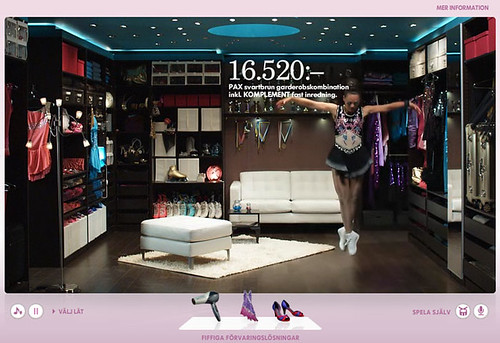
Here is a video preview of some of the dance interaction in the site:


Duncan, of the Inspiration Room, also posted credit information regarding the IKEA website:
The following credits were posted by Duncan on the Inspiration Room Daily:
"The site was developed at Forsman Bodenfors, Sweden by web director Mathias Appelblad, copywriter Fredrik Jansson, art director Anders Eklind, designers Anton Robsarve and Christoffer Persson, agency producers Peter Gaudiano, Charlotte Most, Asa Jansson, account director Philip Mascher."
"An earlier version of the site was developed in 2006, winning a Yellow Pencil at the DandDs, and can be viewed online at Forsman Bodenfors."
"Web development was done at Kokokaka, Gothenburg."
"Filming was shot by director Amir Chamdin via Chamdin & Stöhr, Stockholm, with director of photography Gosta Reiland."
"Music is by Dead Mono."
Cross-posted from the Interactive Multimedia Technology blog.
Sunday, June 1, 2008
Dance Interaction, Gestures, Patents, and Technology: Doug Fox, of Kinetic Interface, poses some good questions...
Doug Fox, of Kinetic Interface, is the author of the blog of the same name, which is part of the GreatDance website.
From looking over Doug's posts, it is clear that he has spent quite a bit of time pondering issues related to dance and technology interaction. According to Doug, Steve Jobs/Apple is working with the Ohad Naharin, a choreographer. He points out that "choreographers are essentially rapid-prototypers who can create the basics of new movement vocabularies in a few hours."
Reflecting on my previous dance training, I think Doug is on to something.
Here are some excerpts from the Kinetic Interface blog:
"The Kinetic Interface blog on Great Dance starts with the premise that by focusing on the body and movement we can better understand, engage with, and contribute to many of the technological and scientific changes that are reshaping our daily lives."
Gesture Patents Point Way to Full-Body Interfaces
"To ask a bit of an improbable question, will dancers be prohibited from certain movement sequences because they are protected by the US Patent and Trademark Office? This is not likely to happen. But what might happen is that the most natural of human gestures and movements may eventually become proprietary instruments of interface designers.
On another front, I would like to create a video contest where dancers were invited to create their own series of gestures and movements that were intended to control new PC and mobile interfaces. I think that dancers would come-up with some highly innovative approaches that had not previously been considered."
Creating Dance for Developers of User Interfaces"Say, you were creating a dance piece for a geeky audience of software developers. How would you go about creating and structuring a dance so that developers could relate to it as if it were, in some sense, the user interface for a software program?.....I would find it very interesting to speak with choreographers who have pondered some variation of my questions connecting dance to user interface design. Or who have created dances for non traditional dance audiences."
For related information about interfaces, Doug Fox recommends reading Alex Iskold's article, The Rise of Contextual Interfaces on ReadWriteWeb. Be sure to read the comments to Iskold's article, if you have the time.
PART TWO
I studied dance formally when I was young, and even through my college years at the University of Michigan. (This was a long time ago- Madonna was in one of my classes!)
Despite all of my dance training, I really did not think about the way dance interaction relates to technology until recently, when I came across Doug Fox's Kinetic Interface blog and the Great Dance website. Not long after that, I had the opportunity to see a performance of Exquisite Interaction at the Visualization in the World symposium. The performance was part of the Dance.Draw project, a collaboration between the Dance and Software and Information Systems (HCI) departments at UNC-Charlotte.
![[ExquisiteInteraction.jpg]](https://blogger.googleusercontent.com/img/b/R29vZ2xl/AVvXsEjHgdHs-M0M_fXtuka0iTsRxZJbTpjX9PCxGyVqCEaXZABt3Vb2lr93M3JNQt36oq0UdwAACsf2xtAU2b08sSzuFelBziegQz3XUcrT5kNVnKn8M3vAERU_Mvw1PXN1pXDR1G_f6xDaTIA/s1600/ExquisiteInteraction.jpg)

- GestureTek, a company that reportedly developed patents for gestures as early as 1991.
- Jeroen Arendsen's A Nice Gesture "Stories of gestures and sign language about perception, semiotics, and technology". Jeroen is Ph.D. student and also an interaction designer and usability specialist.
- Merce Cunningham, a famous choreographer, collaborated with software developers to create the DanceForms choreography software. (Also see the Character Motion website.) "DanceForms 1.0 inspires you to visualize and chronicle dance steps or entire routines in an easy-to-use 3D environment. For choreography, interdisciplinary arts and dance technology applications."

Merce Cunningham Dance Company
- PBS American Masters Documentary on Merce Cunningham, and also John Cage, the musician he collaborated with from 1942-1992. Both were connected with R. Buckminster Fuller, the guy who revolutionized the field of engineering.
- Cycling74 is the software company behind Max/MSP/Jitter and other cool stuff -Cycling74 products are used by musicians, multi-media artists, and dancers. Academic/student discounts are available.




