Friday, November 11, 2011
The Space and Culture Blog- worth a visit!
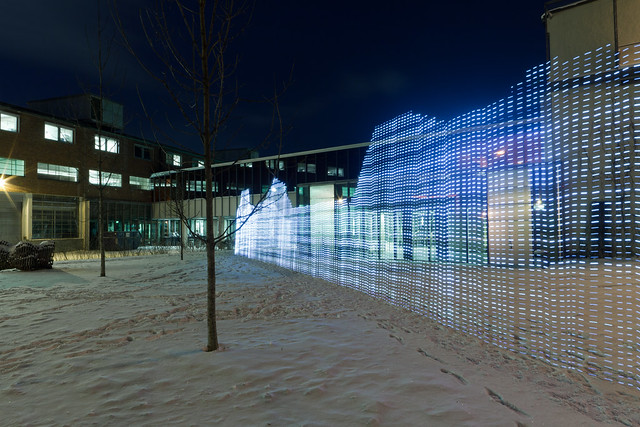
WiFi Measuring Rods, Oslo School of Architecture
Making WiFi Visible - Network City
Robert Shields, 10/6/11
Note: The above post provides a link to Making 'Immaterials: Light painting WiFi', a post written by Einar Sneve Martinussen the YOUrban blog. YOUrban is a research project at the Institute of Design within the Oslo School of Architecture and Design.
Sound, Space and the City
Catherine Scheelar, 10/10/11
Sound, Space, and the City: Civic Performance in Downtown Los Angeles
"In Sound, Space, and the City, Marina Peterson explores the processes-from urban renewal to the performance of ethnicity and the experiences of audiences--through which civic space is created at music performances in downtown Los Angeles."
Mapping Flickr Photos and Twitter Tweets
Rob Shields, 7/20/11
RELATED/SOMEWHAT RELATED
Cognitive Cities Conference
Adam Greenfield's Presentation


Tuesday, November 24, 2009
Great Blogs about Natural User Interfaces: Joshua Blake Deconstructing the NUI & Jonathan Brill : Multitouch Maven_ (Point and Do)
Josh Blake is a .NET, SharePoint, and Microsoft Surface consultant for InfoStrat, located in Northern Virginia. If you are interested in natural user interfaces, you'll appreciate his blog, Deconstructing the NUI He posts only a few times a month, but what you'll find is thoughtful insight regarding natural user interfaces that rely on multi-touch or gesture interaction.
Here are a few of Josh's posts:
The Natural User Interface Revolution
Pleasing the Brain with Magical Interfaces
Deconstructing: SilverPAC's Multi-Touch Website
Limiting the Multi-touch Vocabulary
Jonathan Brill is an independent consultant who focuses on multitouch product strategy, design, and development, and previously served as an embedded consultant at Microsoft Surface. His blog, Multitouch Maven, provides a wealth of information regarding multi-touch and gesture interaction and interfaces.
Here are a few of his posts:
New Multitouch Interface Conventions
Creating Intuitive Gestures Using Object Orientation
Using Auras to Maintain User Orientation
Saturday, August 29, 2009
Artefact's Blog: Contextual Interventions for Sustainable User Experiences
I recently came across a thoughtful blog post about contextual design and user experience, written by "Dave" at Artefact. In his post, Dave discusses the variety of monitors, interfaces, and devices that have recently been developed to help people monitor and save the energy that they use:
Contextual Interventions for Sustainable User Experiences
"There is a great opportunity to make contextual interventions during people’s behaviors. The intervention might be a change in affordances or simply information. It’s like a nudge but the key is to design influences that are tightly coupled with specific user behavior, making a feedback loop that takes advantage of the way we naturally learn. Thus, it isn’t helping analyze your utility bill, it’s suggesting that you turn off the faucet while you’re not using it."
I especially liked Dave's example of the Disappearing Pattern Tiles. If you stay in the shower too long, the pattern disappears. For people who daydream too much in the shower, this clue might really help them conserve water, in an unobtrusive way.
Disappearing Pattern Tiles
This might work for certain types of people, but some of us might do better with a timer that turns the water from hot to cold after so long. A wake-up call while you take your morning shower! I guess this wouldn't be considered contextual, but it might change long-shower taking behaviors among some of us pretty quickly!
The people who make up the Artefact group are 'big advocates of surface computing and natural user interfaces". Artifact is a research and design studio in Seattle, WA, that designs user-focused software and technology product and services. The Artefact blog posts are informative.
Friday, June 5, 2009
Still a dream: Ubiquitous Women in Technology
I recently received the following link in an email and thought I'd share some information related to this topic:
ACM-WCBH Initiative Finds Large Gender Gap in Teens Interested in Computing as a Career
Report (pdf)
"The NIC initiative began in late 2007 with a review of the question, “Why is interest in computer
science declining in U.S. colleges?” At that time, a recently published UCLA study found that the number of undergraduates choosing a computer science major was down a stunning 70% since2000.1 And according to a 2007 Computer Research Association (CRA) Taulbee Survey, therewere double-digit declines in enrollments for graduate degrees in computer science.2 Althoughit may be hard to believe, more than 80% of today’s college freshmen—the very students that grew up with computers and are now called “digital natives”—said they had no idea whatcomputer science majors actually do."
"The number of computer science majors is still not meeting projected workforce needs, and the Taulbee Survey points out that diversity in computer science programs continues to be poor. For example, just over 10% of the bachelor’s degrees were awarded to women."
Graphic related to the study (THE Journal)
RELATED
ACM's Committee on Women in Computing
Association for Women in Computing
National Center for Women & Information Technology
Woman & Information Technology By the Numbers pdf
GeekGirl Blogs
Girl Geeks.org
IEEE Women in Engineering
IEEE CIS: Women in Computational Intelligence
Engineering Pathway:
"This blog on engineering education is maintained by the Engineering Pathway, a portal to high-quality teaching and learning resources in engineering, applied science and math, computer science/information technology, and engineering technology and is designed for use by K-12 and university educators and students. The K-12 engineering curriculum uses engineering as a vehicle for the integration of hands-on science and mathematics through real-world designs and applications that inspire the creativity of youth. Users may search over K-12 engineering lessons and activities, as well as other K-12 resources, by many criteria - including content focus area, grade level and educational standards...."
The website has great resources about a multitude of topics related to engineering, computing, and related technologies. I especially liked the sections related to "broadening participation"


The Athena Factor: Reversing the Brain Drain in Science and Technology
Try Engineering.org
Not-so-related:
Interesting posts from Engineering Pathways:
Engineering Education "Today in History" Innovation in Shopping Carts
Alice Agogino, 6/4/09
Engineering Education "Today in History" Apple II Goes on Sale
Alice Agogino, 6/5/09




