Tuesday, March 31, 2009
Everyware Health Care: Mobile Patient Communicator- an interactive touch screen for patient education
Via the Cloud Computing Journal:
New Mobile Patient Communicator Gives Patients and Interactive Education Tool and Boosts Nurse Productivity
"“Nurses spend a lot of time simply escorting patients from the waiting room to the exam room. We have found that the MPC can effectively room patients, while creating more value-added time for nurses to assume additional clinical tasks,” said Kelvin Buncum, president of International Medical Solutions. "
"“A compelling attribute of the MPC is that it increases nurse and support staff productivity, since it frees up caregivers to devote more of their valuable time to patient evaluations,” noted Buncum, who with his partner Jaime Mitchell, developed the MPC in conjunction with a family practice physician who saw the need to improve his medical support staff‟s productivity to meet growing demand and patients‟ knowledge of their chronic disease."
"During their wait time patients can view educational videos in private to learn about critical matters involving their acute illness, chronic condition and procedures. The user-friendly MPC delivers subject matter specific to the patient‟s stage of care, treatment regimen, rehabilitation, care plan and disease management."
"Serving as a personal health tutor and trainer, the MPC can perform pre- and post-instruction tests, scoring patients on their disease knowledge and retention. Healthcare providers can also grant users access to their clinical Web portal and patient applications via the MPC, providing significant utility over stationary kiosks."
The International Medical Solutions company offers a selection of touch-screen mobile patient communicator devices that would have come in handy during my father's longer-than-expected stay in an intensive care unit:
7 Inch MPC
10-Inch MPC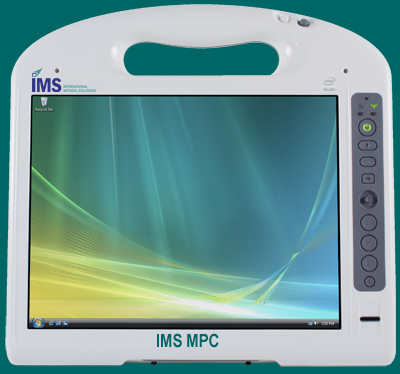
12 Inch MPC
11-inch Rugged MPC
Applications:
Whitepaper (pdf)


Sunday, March 8, 2009
"Everyware" Health Care: A Personal Focus

For the next few weeks, I'll be focusing some on my experiences with technology and health care.
This time, my posts will be on a more personal level. As I write this post, I am sitting in the family waiting area of the cardiac ICU at the Cleveland Clinic. My dad's surgery was Tuesday, and it is now Sunday, so I have had plenty of time on my hands to observe how technology is used to deliver his care, monitor his progress, and support his recovery.
Since I view things from a broader human-computer interaction perspective, I've decided to share some of my thoughts the"Hospital UX" picture, putting myself in the shoes of patients, family members, and medical professionals.

This is the new lounge where families wait while their loved ones undergo cardiac surgery. The old family waiting area at the Cleveland Clinic had a cozy, home-like feel, with comfortable chairs and cheery art. The new waiting area has a very sterile, minimalist feel. The chairs are NOT comfortable, especially if you are middle-age or older and have the usual aches and pains!
Corridor to Nowhere?

Some of the corridors at the hospital have a surreal, institutional feel.
Hospital Corridor Eye Candy

You are.... where?!

It is still quite difficult to figure out where you are and how to get to where you are going.
Microsoft Health Common User Interface: Patient Journey Demonstrator
via Martin Grason: Adventures of a 'Devigner'
Future Hospitals form Designit 12/30/08
"How can hospitals offer a better service – for patients and visitors? And improve working conditions for staff? Designit has been asked to find the answer by applying explorative, user-driven innovation at the heart of public sector delivery: Odense University Hospital, Denmark's largest hospital."
"The project, which starts in January, aims to deliver groundbreaking service innovation that could serve as a blueprint for future public healthcare improvements – in Denmark and abroad."
Obama's Plan to Digitize Medical Records Draws Criticism from Doctors
Dan Nosowitz, Gizmodo, 3/7/09
Computer Will See You Now
Anne Armstrong-Coben, New York Times, 3/5/09
"Now that I’ve been using a computer to keep patient records — a practice that I once looked forward to — my participation with patients too often consists of keeping them away from the keyboard while I’m working, for fear they’ll push a button that implodes all that I have just documented...Room is provided for text, but in the computer’s font, important points often get lost. I have half-joked with residents that they could type “child has no head” in the middle of a computer record — and it might be missed....The personal relationships we build in primary care must remain a priority, because they are integral to improved health outcomes. Let us not forget this as we put keyboards and screens within the intimate walls of our medical homes.."
Note: Anne Armstrong-Corben is a clinical professor of pediatrics at Columbia.
Obama's Big Idea: Digital health records
David Goldman, CNN Money 1/12/09




