Friday, April 17, 2009
Daniel Michelis: Interactive Displays in Public Spaces Blog
Daniel Michelis recently completed his Ph.D. dissertation on a topic that is dear to my heart. Information about his research can be found on his Interactive Displays in Public Spaces blog.
Here are links to a few of his posts:
Interactive Displays: Perception, Awareness, and Interaction
Evaluating Interaction with Display Applications in Public Space
I especially like the diagrams Daniel uses to depict zones of interaction:
Figure 3: Four-phase Model
(Source: Daniel Michelis (2009), according to: Vogel and Balakrishnan, 2004)
(Author: Daniel Michelis, Institute for Media and Communications Management, University of St. Gallen)
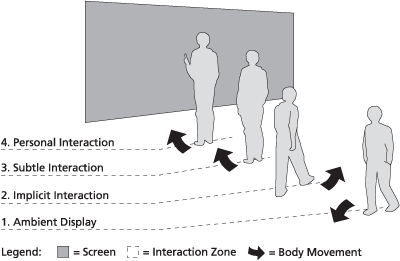

Figure 1: Perception and Usage of Interactive Displays
(Source: Daniel Michelis (2009), according to: Brignull & Rogers, 2003)


Friday, April 10, 2009
Sprint's Welcome to the Now Network: "What's Happening Now" Infographic-like Commercial
I saw this commercial last night and thought I'd share it.
Friday, April 3, 2009
The Internet of Things can be Cute: MIR:ROR by Violet:
The MIR:ROR application supports memory and interaction with your computers as well as your Web 2.0 applications via a RFID Stamp. You can even figure out the last time you fed your fish!
Here is some of the promotional information from the Violet website:
"Mir:ror makes your everyday objects interactive, intelligent, communicant. Stick RFID Ztamps on them and show them to the Mir:ror: your keys will send e-mail to tell someone you’ve got home, your pills know when you’ve swallowed them, your toys play videos… Thousands of uses you can easily program through a Website."


"Nano:ztags are lovable micro-rabbits with a RFID Ztamp in their tummy. Program them to play any content or application you choose each time you show them to a Nabaztag:tag or Mir:ror."
(Also posted on the Interactive Multimedia Technology Blog)
Albrecht Schmidt's User Interface Engineering Blog: Great Links, References, and Resources
For more information, take a look at my post on the Interactive Multimedia Technology blog:
Albrecht Schmidt's User Interface Engineering Blog: Great Links, References, and Resources
Thursday, April 2, 2009
Everyware Healthcare: IT in the LTACH and beyond
I'm visiting my dad who recently was transferred to a LTACH. LTACH stands for Long Term Acute Care Hospital. One of the goals of an LTACH is to work with people who have medically complex issues, often after a longer-than planned stay in an intensive care unit at a "regular" hospital, and then get them to the point where they can return home, with the maximum degree of independence as possible.
Given the fact that my dad has been deeply immersed in the medical/health care system lately, and the given the fact that I'm a techie, it has been difficult to ignore the wellspring of health care-related technology news peculating around, especially since the new stimulus plan has a provision for the funding of health care IT. This is explained in detail the following presentation from the McKessen EMRresource blog:

I'll comment a bit on the following articles and links in my next post:
iPlan Net

"iPlan Net Session Sharing enables two or more clinicians at different locations to work on the same plan simultaneously. With Session Sharing, physicians no longer need to be in the same room to collaborate—it's all possible over the iPlan Net browser...iPlan Net connects entire surgery, radiotherapy and radiology departments—increasing cooperation, productivity and efficiency."
G.E. and Intel Working on Remote Monitors to Provide Home Health Care
Steve Lohr 4/2/09 New York Times
Intel Health Guide

"The Intel® Health Guide offers interactive tools for personalized care management and includes vital sign collection, patient reminders, surveys, multimedia educational content, and video conferencing and alerts."


GE HealthCare

GE Healthcare Community Technology Update: Aging in Place pdf
New Touch Screen Monitors to Reduce Hospital Patient Waiting Times
Kindred Hospitals Customer Story (pdf)
Effective Healthcare Identity Management: A Necessary First Step for Improving U.S. Healthcare Information Systems Brief (pdf) (Smart Card Alliance)
FDA Probes Potential Overlap Between Electronic Health Records and Devices
DOD, VA set new target for lifetime health record
Government Health IT, Peter Buxbaum 3/27/09
The Stimulus Plan's Impact on the Healthcare Business Model
Scott Anthony, Harvard Business
.
Tuesday, March 31, 2009
Linked Senior: Technology Enhanced Life in Senior Communities
Today I received an e-mail from Charles De Vilmorin, from Linked Seniors, about their entertainment products and services for people who live in senior communities, including skilled nursing facilities.
Invention Helps Seniors Get Plugged In: Device Caters to Interests, Needs and Tastes
Fredrick Kunkle, Washington Post, 3/19/09
Here is a quote from the article:
"Two young inventors have created a device, with the help of hands-on testing at a Fairfax County retirement community, that they say might change the way older Americans get news and entertainment.
Using modified MP3 players, computers and large touch-screen monitors in high-contrast colors for people with impaired vision, Charles De Vilmorin and Herve Roussel have created a digital kiosk that serves as a sort of iPod for older people."SOMEWHAT RELATED:
AskGeriatric.com
who moved my dentures? musings on aging
Internet Surfing Better than Reading for Brain Stimulation
"“The study results are encouraging, that emerging computerized technologies may have physiological effects and potential benefits for middle-aged and older adults,” says principal investigator Gary Small, a professor at the Semel Institute for Neuroscience and Human Behavior at UCLA and director of the campus’ Memory and Aging Research Center."
Everyware Health Care: Mobile Patient Communicator- an interactive touch screen for patient education
Via the Cloud Computing Journal:
New Mobile Patient Communicator Gives Patients and Interactive Education Tool and Boosts Nurse Productivity
"“Nurses spend a lot of time simply escorting patients from the waiting room to the exam room. We have found that the MPC can effectively room patients, while creating more value-added time for nurses to assume additional clinical tasks,” said Kelvin Buncum, president of International Medical Solutions. "
"“A compelling attribute of the MPC is that it increases nurse and support staff productivity, since it frees up caregivers to devote more of their valuable time to patient evaluations,” noted Buncum, who with his partner Jaime Mitchell, developed the MPC in conjunction with a family practice physician who saw the need to improve his medical support staff‟s productivity to meet growing demand and patients‟ knowledge of their chronic disease."
"During their wait time patients can view educational videos in private to learn about critical matters involving their acute illness, chronic condition and procedures. The user-friendly MPC delivers subject matter specific to the patient‟s stage of care, treatment regimen, rehabilitation, care plan and disease management."
"Serving as a personal health tutor and trainer, the MPC can perform pre- and post-instruction tests, scoring patients on their disease knowledge and retention. Healthcare providers can also grant users access to their clinical Web portal and patient applications via the MPC, providing significant utility over stationary kiosks."
The International Medical Solutions company offers a selection of touch-screen mobile patient communicator devices that would have come in handy during my father's longer-than-expected stay in an intensive care unit:
7 Inch MPC
10-Inch MPC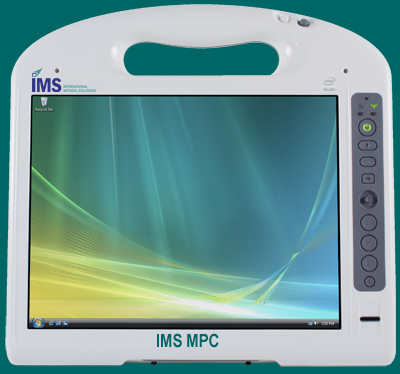
12 Inch MPC
11-inch Rugged MPC
Applications:
Whitepaper (pdf)
Everyware Health Care: Real Life Examples
I'm devoting some of the posts I write for this blog on the topic of "Everyware Health Care", an over-arching concept that emphasizes how existing and emerging technologies can help to improve delivery of health care and also enhance health-care user experience.
About 182,000 patients at the Cleveland Clinic use MyChart, an in-house electronic medical record. More recently, the hospital is testing out Google Health Records with 1,500 patents and Microsoft's Health Vault with 500 patients. According to an article in the Plain Dealer, the hospital supports the use of electronic medical records because it can reduce costly mistakes and redundancies.
| Checking blood pressure |
The video above shows how blood pressure can be charted and tracked daily, providing the physician with information that can better monitor and adjust medications. With Microsoft's Health Vault system, patients can upload medical information via a glucometer, pedometer, weight scale, or blood pressure monitor, depending on the nature of their health concerns. The system provides a means for uploading information to the system wirelessly, which is important for people who travel a lot for their jobs.
My Family Health Portrait is an on-line tool provided by the U.S. Department of Health and Human Services that allows people to enter their family health history, create drawings of family health history to share with health care providers or other family members, and to integrate the health history of other family members into your own. The source code for developers is available for free.
Some of the basic work related to integrated electronic medical information systems is hospital-focused Microsoft's Amalga software, which has been rolled out in several hospitals around the world. The following video shows how the system works at Bumrungrad International Hospital, and how it improves the hospital user experience, not only for the patient, but for the medical staff as well:
RELATED
Cleveland Clinic makes electronic medical records personal, more accessible
Sarah Jane Tribble, Plain Dealer 3/31/09
News about wireless technology in healthcare from Healthcare Informatics
Telehealth Services
POST: ElderGadget: Tech Devices for Health
POST: "Everyware Health Care": A Personal Focus
POST: Everyware Healthcare: Microsoft Health's Common User Interface website, usable health care applications, pervasive health games....
POST: SoftKinetic 3D Gesture Recognition for Games and Rehabilitative Play
Microsoft plans big move into European healthcare market
Tola Sargeant, Ovum
"Amalga does not complete with electronic health or patient records, it compliments them. As well as providing a single view of the patient, it enables analysis of all data from across the organization, which in turn can be used to drive change and performance improvement."
Microsoft releases hospital IT system as Amalga
Dana Blankenhorn, ZDNet Healthcare 2/13/08
Will Behavioral Health Be Left Behind?
David Raths, Healthcare Informatics 3/30/09
"While the stimulus bill was being written, Scalia said, his company worked with the National Council for Community Behavioral Healthcare to try to have the Medicaid incentive language changed. They were not successful, he added, because there was a concern that it would increase the cost of the incentive section above the $20 billion mark."
Monday, March 30, 2009
nnub: Local Community Interactive Noticeboard Software

"Nnub Moggill is a touch-screen digital noticeboard located at the Moggill General Store. All content on the digital noticeboard is generated by users of Nnub Moggill and by aggregating content relevant to the local community from other sources. Content can be uploaded to the digital noticeboard at http://www.nnub.net."
"Nnub aims to help build better, searchable, indexable, information for local communities. Our philosophy is that anyone can post. At Nnub we moderate web submissions only for porn and profanity."

The Moggill nnub follows the principles of the Seattle Community Network
"Nnub is a research project conducted by researchers at the Queensland University of Technology and the University of Queensland as part of the Australasian CoOperative Research Centre for Interaction Design (ACID).RELATEDNnub: Getting to the Nub of Neighbourhood Interaction (pdf)
Urban Interfaces (pdf)
RFID, Mobile Devices, and Museum Interaction
The above video demonstrates how RFID technology from Anerian can enhance the user's experience in museum settings. The prototype allows people to drive down micromedia-audio, video, or text to mobile devices to gain more information. The system also provides real-time analytics about the way visitors interact in museums.
Thursday, March 26, 2009
ElderGadget Blog: Useful Tech and Tools
Today I came across the ElderGadget Blog when I was searching for technology that might be helpful to my father, who recently spent the last few weeks in an intensive care unit.
Here are a few things I found on the blog, including what I found when I followed a link to the bindependent website:
Smart Table: A Broadband Communication System for the Elderly
ID Studiolab, Delft University of Technology, NL
"The smart system is aimed to prevent possible social isolation between elderly people and their social contacts. It consists of the Smart Table and the Smart Messenger, which provide easy and intuitive way for elderly people to benefit from the advantage of communication technology and improve the satisfaction of their social activities."
"During the design research, a working prototype is made and evaluated by a user test. The Smart Table offers people a way to use broadband communication without the need for a computer. The television will be used for video communication (web-cam) and the table as user-interface. On the table contact persons can be selected and images and video can be shared. The elderly person can capture images that will be shared instantly. The contact person can select images from his or her computer, which will be projected on the table of the elderly person". (TU Delft - Faculty Industrial Design Engineering - Master Design for Interaction - Project Interactive Technology Design - Vincent Steurs & Juin-Yi Huang) 
Demy Kitchen Safe Touchscreen Reader
Photo Watch
Clarity-C900: Amplified Big Button Cell Phone 
911 Guardian: "Tiny wearable speakerphone"
Extra Large TV Remote Control

SmartShopper: Electronic grocery-list maker

Bierley's ColorMouse Video Magnifier

RELATED
Live from CES - Dakim's Brain Fitness Keeps Seniors Sharp

Previous post: Ubiquitous Computing - Grandpa and grandkids use a webcam and Skype across the miles
YouTube Vlogger: Geriatric1927
Geriatric Gripes and Grumbles
Tuesday, March 24, 2009
The interaction that had me at "hello world": SixthSense TED presentation by Pattie Maes, of MIT's Fluid Interfaces Group

Photo Via Google Images
Although research about multi-touch and gesture interaction has been going on for many years, it took the release of the 2002 movie Minority Report to fuel the recent mini-explosion of interest. Members of MIT's Fluid Interfaces Group have been working on projects that are making the science fiction of the film a reality, and at a reasonable price.
(Similar post on the Interactive Multimedia Technology blog)
In the following video, Pattie Maes and Pranav Mistry,of MIT's Fluid Interfaces Group, demonstrate SixthSense, wearable technology that incorporates a video camera, a projector, a digital camera. I especially like this application because it supports multi-touch and multi-user interaction. Although it is in the prototype/demo stage, it looks like it is a mobile technology that has potential.
From the SixthSense website:
"The SixthSense prototype is comprised of a pocket projector, a mirror and a camera. The hardware components are coupled in a pendant like mobile wearable device. Both the projector and the camera are connected to the mobile computing device in the user’s pocket. The projector projects visual information enabling surfaces, walls and physical objects around us to be used as interfaces; while the camera recognizes and tracks user's hand gestures and physical objects using computer-vision based techniques. The software program processes the video stream data captured by the camera and tracks the locations of the colored markers (visual tracking fiducials) at the tip of the user’s fingers using simple computer-vision techniques. The movements and arrangements of these fiducials are interpreted into gestures that act as interaction instructions for the projected application interfaces. The maximum number of tracked fingers is only constrained by the number of unique fiducials, thus SixthSense also supports multi-touch and multi-user interaction."


Sunday, March 22, 2009
The Lucid Project: Internet of Things, Mobility, and Context Aware Services
The following picture, from Open Gardens, shows how our mobile devices can be used to interact with the "Internet of Things", also known as the "Web of Things":
The Open Gardens blog is authored by Ajit Jaokar.
The slides below are from one of Jaokar's presentations about the impact of open source technologies and mobile communication:
Related to this topic is the concept of mobile social software, also known as MoSoSo. For more information read this paper about Mobile Social Software, a thesis written by Clint Heyer.
Friday, March 20, 2009
"Web Meets World": User Experience of Embedded Systems and Interactive Wireless Sensor Networks...
In my opinion, HCI/Usability/UX intervention is sorely needed in the converging fields of embedded systems and wireless sensor networks. I fear what the future will hold if usability and user experience factors do not receive attention.
I think there is hope, despite my quote in a previous post about some usability issues related to the SmartGrid City project.
For a good overview of the future of sensor networks and ambient technologies, read the transcript of Tim O'Reilly's "Web Meets World" keynote presentation from the 2008 Web 2.0 Expo, or watch the video below:
O'Reilly asks, "What are our best and brightest working on?" and "Are we working on the right thing?" (He even touches on Richard Bookstaber's "A Demon of our own Design: Markets, Hedge Funds, and the Perils of Financial Innovation", a book published in 2007 that discusses how the best and brightest developed innovations that made investments more risky. We now know the outcome of those innovations!)
Summer Reading?!

A number of different system concepts have become apparent in the broader context of embedded systems over the past few years. Whilst there are some differences between these, this book argues that in fact there is much they share in common, particularly the important notions of control, heterogenity, wireless communication, dynamics/ad hoc nature and cost.
The first part of the book covers cooperating object applications and the currently available application scenarios, such as control and automation, healthcare, and security and surveillance. The second part discusses paradigms for algorithms and interactions. The third part covers various types of vertical system functions, including data aggregation, resource management and time synchronization. The fourth part outlines system architecture and programming models, outlining all currently available architectural models and middleware approaches that can be used to abstract the complexity of cooperating object technology.
I wonder how much of this book is devoted to usability and user-experience topics!
Graphics for Embedded Systems
Niall Murphy's PanelSoft : User Interfaces and Usability for Embedded Systems Articles
Dr. Kristof Van Laerhoven (Multimodal Interactive Systems)
TinyOS (free, open source operating system for wireless sensor networks)
Siftables: Physical, Natural Way to Interact with Information and Media
My post: Tangible & Fluid User Interfaces Part I: Siftables
Link to previous post:
The UX of SmartGridCity: Control Your SmartHouse Remotely, Online
The UX of SmartGridCity: Control Your SmartHouse Remotely, Online
My interest in interactive wireless sensor networks has been growing over the past several months. This technology supports how we will interact with our "things" in the world. It sounds futuristic, but the technology is here and is in the implementation stage in Boulder, Colorado, known as SmartGrid City.
There are some issues facing the usability of this system for homeowners who participate in the SmartGrid City project. Here is an example from an article in the Wall Street Journal:
"...The Petersons' experience with the smart grid has not been entirely smooth. Mrs. Peterson says it can be cumbersome -- and "boring" -- to use the smart-grid Web site to manage her home's energy use. She has to set more than a dozen data points just to get her bedroom temperature where she wants it through the week.
Her husband finds some of the online charts that track his home's energy use too abstract. "If I told you that today you saved four pounds...of carbon emissions, what does that mean to you?" he asks. He prefers when the software serves up analogies he can visualize: He's saved enough energy to microwave 9,550 frozen pizzas or to light a major-league ballgame for three innings."
The system, of course, was designed by engineers, right?More Information:
If you click on the graphic below, you will link to an interactive graphic from the Wall Street Journal that gives a good visual overview of a house that is linked to the SmartGrid City:

"SmartGridCity is the nation's first fully integrated smart grid community and will boast the largest and densest concentration of these emerging technologies to date."

More information from the Xcel website:
SmartHouse Graphic and Description (pdf)
"Xcel Energy's SmartGrid Consortium is imagining a future that would allow you to communicate your energy choices to the power grid and automatically receive electricity based on your personal needs".
- Advanced sensors distributed throughout the grid and a high-speed communication network tie the entire system together
- Smart Thermostat
- Smart Appliances
- Smart Meter
- Plug-in Hybrid Electric Car
- A dynamic system rich in information technology
- High-speed, real-time, two-way communications
- Sensors throughout the grid enabling rapid diagnosis and connections
- Decision making data and support for peak efficiency
- Distributed generation technologies (such as wind turbines, solar panels, and plug-in hybrid electric vehicles)
- Automated "smart substations"
- In-home energy control devices
- Automated home energy use


Tuesday, March 17, 2009
Eyeborg: WebCam in a Prosthetic Eye; Prostetic Finger with USB Drive
The Eyeborg Project takes Microsoft's SenseCam concept to the next level.
From the Eyeborg Project Website:
"Take a one eyed film maker, an unemployed engineer, and a vision for something that's never been done before and you have yourself the EyeBorg Project. Rob Spence and Kosta Grammatis are trying to make history by embedding a video camera and a transmitter in a prosthetic eye. That eye is going in Robs eye socket, and will record the world from a perspective that's never been seen before."
Jimmy Fallon Spoofs the Eyeborg Project from eyeborg on Vimeo. Jimmy insists that he received an Eyeborg when he had Lasix surgery to improve his eyesight.
CONCEPT DRAWING OF THE EYEBORG BY JOENIS NORAC
RELATED:
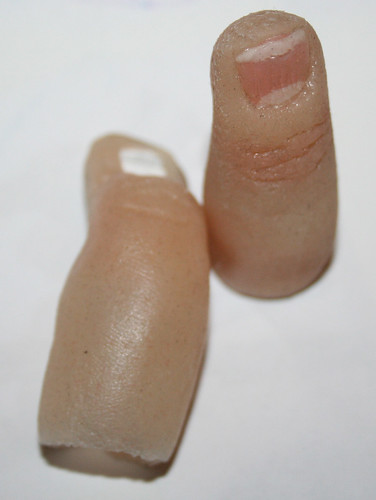
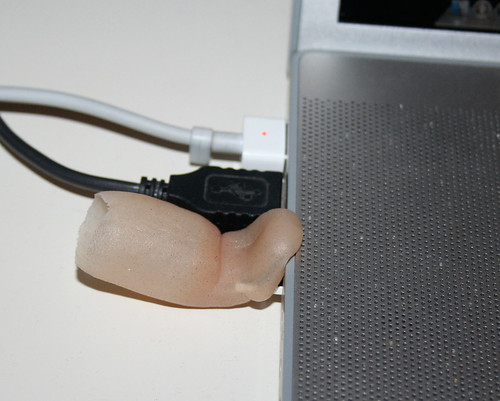
Finn Creates USB Finger Drive
Jerry Jalava, a computer programmer who lost his finger in an accident, created a prosthetic finger that contains a USB drive:
UPDATE: Microsoft's SenseCam Aids Memory Recall
From the
"SenseCam is a wearable digital camera that is designed to take photographs passively, without user intervention, while it is being worn. Unlike a regular digital camera or a cameraphone, SenseCam does not have a viewfinder or a display that can be used to frame photos. Instead, it is fitted with a wide-angle (fish-eye) lens that maximizes its field-of-view. This ensures that nearly everything in the wearer’s view is captured by the camera, which is important because a regular wearable camera would likely produce many uninteresting images."
New study proves that Microsoft's sensory innovation aids memory recall
Technology Review Article
Images from Microsoft Research:


SenseCam Videos
Research and Publications





